 |
| The FG's free 100MB daily data is restricted to approved educational websites. |
Imagine accessing your JAMB CBT portal without borrowing your neighbor's Wi-Fi, or reviewing NYSC SAED module notes on your own phone without watching every kilobyte like it's precious gold. That is the promise of the Federal Government's Free Daily Data Initiative, rolled out October 1, 2026. Yet most news coverage stops at the headline: "100MB free daily data for students." This guide fills that gap.
The Free Daily Data Initiative is a government-backed programme giving eligible Nigerian students up to 100MB of zero-rated data every day, reserved specifically for approved educational platforms, without counting against your regular paid bundle. What follows is a complete breakdown: who qualifies, how to activate it, which networks participate, what the data realistically covers, and how to protect yourself from scammers exploiting the confusion around this rollout.
I have spent over a decade mentoring Nigerian students through JAMB preparation, scholarship applications, and digital skills training. This is the practical breakdown I wish existed the moment the programme was announced.
What the Free Daily Data Initiative Actually Is
The Free Daily Data Initiative provides Nigerian students with a daily allocation of 100MB zero-rated mobile data, renewed every 24 hours, for accessing designated educational platforms and content. "Zero-rated" means the data does not deduct from your regular paid bundle; it is a separate, free allocation that telecom networks route exclusively to approved educational websites and apps.
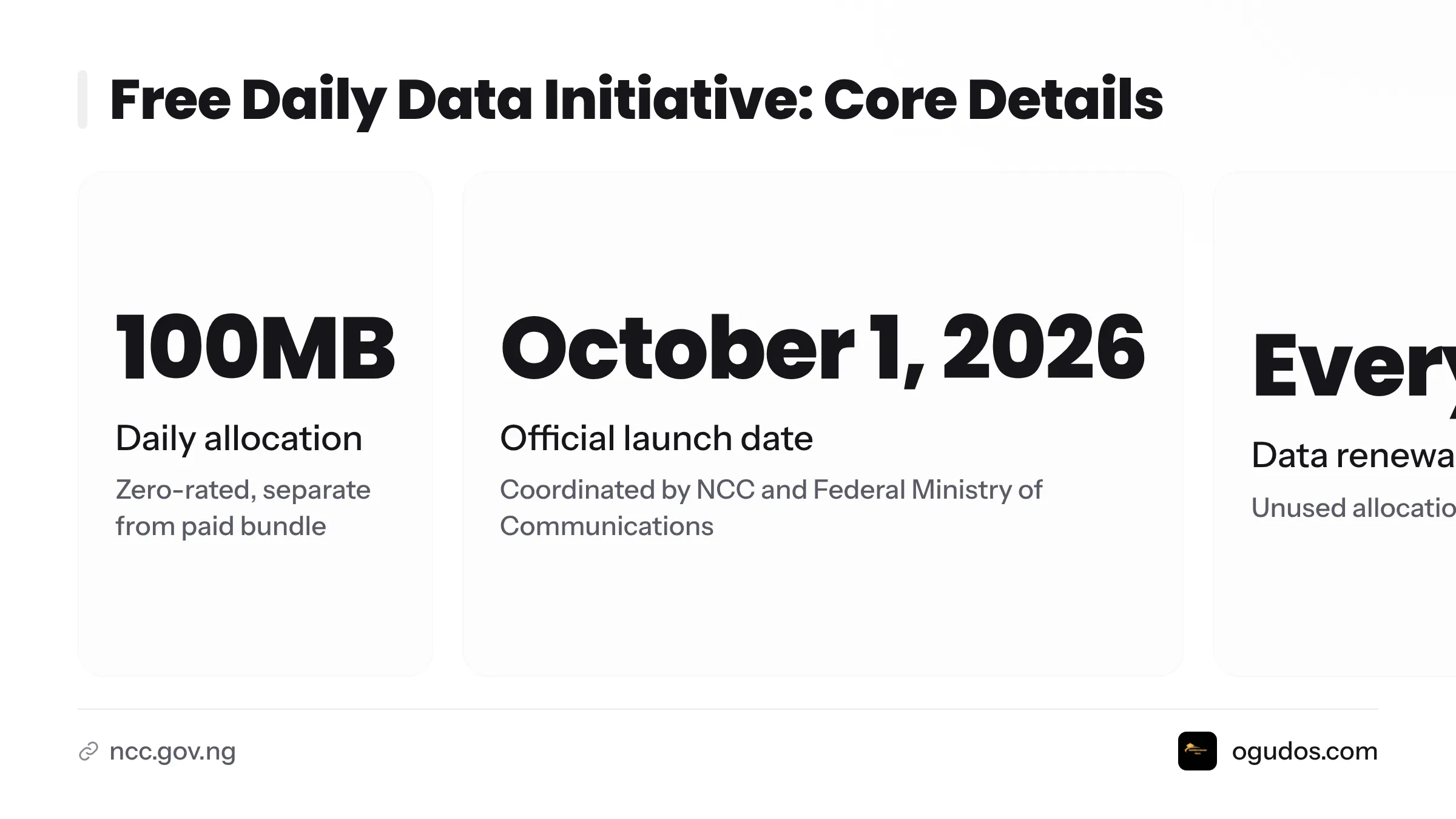
The initiative operates under a framework the Nigerian Communications Commission (NCC) calls the Framework for Zero-Rated Access to Educational Platforms and Content. The core idea is straightforward: remove the cost of data as a barrier between Nigerian students and the internet-based learning material they need.
Who Announced It and When
The Federal Government announced the programme through the NCC, coordinating with the Federal Ministry of Communications, Innovation and Digital Economy. The official launch date is October 1, 2026. TVC News Nigeria covered the announcement as part of the administration's push to widen digital access for learners across Nigeria. Several national outlets reported the story the same week, though most coverage has remained at headline level rather than explaining how the programme actually works.
The rollout is still being finalized across networks region by region, so some details - like exact eligibility verification steps and the complete platform list - are still being confirmed. Throughout this guide, I will flag where you should verify directly with the NCC or your network provider rather than relying on secondhand accounts.
Why the Government Created It
Nigeria's digital divide cuts deep. Millions of students, particularly in rural and lower-income households, cite the cost of data as their biggest barrier to online learning, exam preparation, and research. The Federal Government designed this initiative as a direct response: ensuring that limited data money does not stand between a student and a JAMB portal, a university e-learning platform, or a scholarship application.
This is not Nigeria's first attempt at digital inclusion for education. The NCC has piloted zero-rating before, and networks like MTN Nigeria and Airtel Nigeria have offered their own discounted education data bundles. What sets this initiative apart is its nationwide scale and coordination rather than being an operator-specific promotion.
Key Facts at a Glance
Before diving deeper, here is the essential reference snapshot every student should save.
Detail | What You Need to Know |
|---|---|
Data amount | Up to 100MB per day, zero-rated |
Start date | October 1, 2026 |
Renewal | Resets every 24 hours; unused data does not roll over |
Implementing body | Nigerian Communications Commission (NCC), with the Federal Ministry of Communications, Innovation and Digital Economy |
Intended users | Eligible Nigerian students (secondary, tertiary, and related categories) |
Intended use | Access to designated educational platforms and content only |
Networks | Rolling out across major Nigerian telecom operators |
Cost to student | Free, no airtime or subscription charge |
Always cross-check this reference against the NCC's official website as the programme matures.
Who Qualifies for the Free 100MB Daily Data?
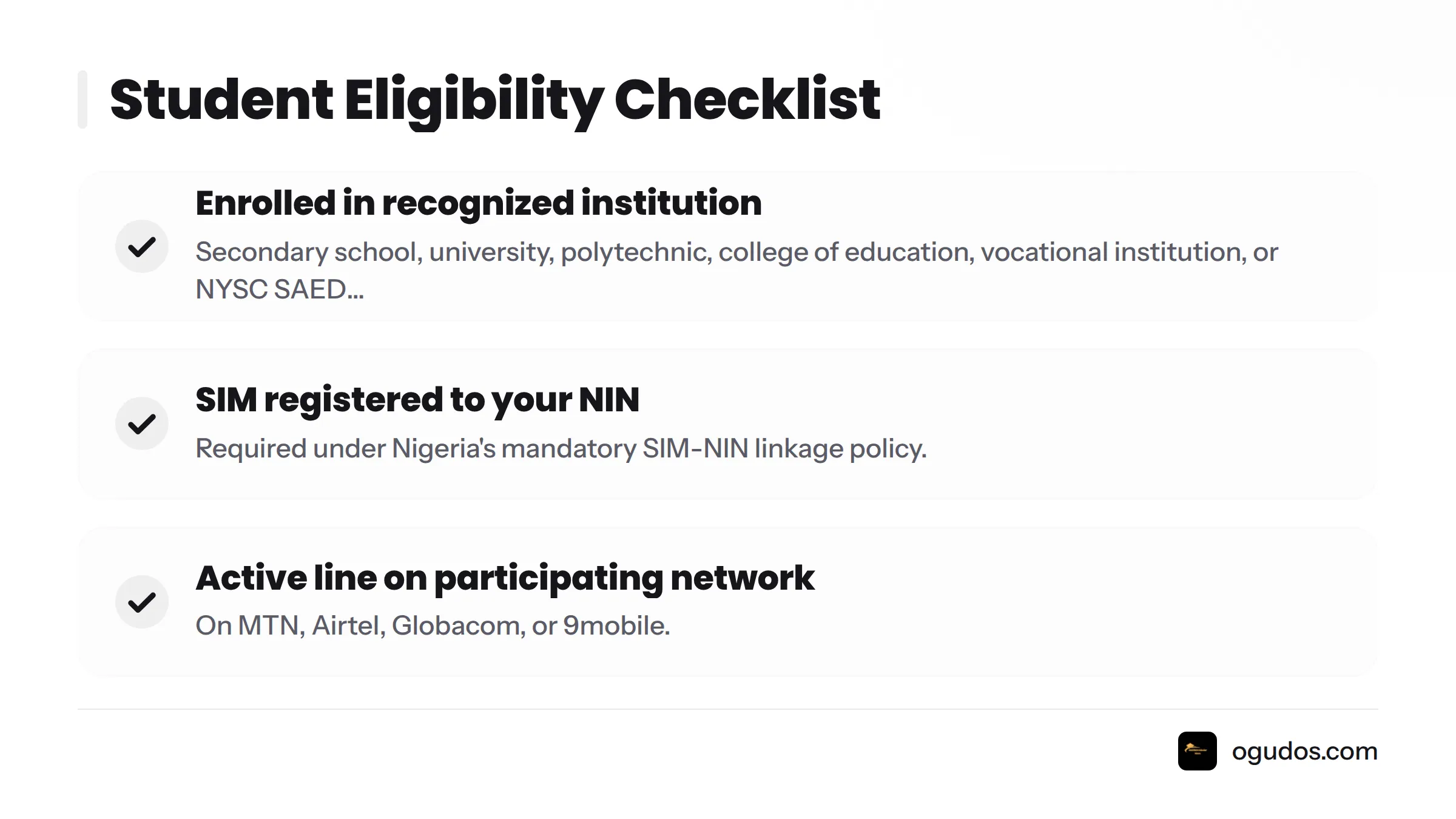
Eligibility centers on verified student status. You generally need to be enrolled in a recognized Nigerian educational institution and able to confirm that status through your school or a linked registration process.
Student Categories Most Likely to Qualify
Based on the programme's stated purpose and similar education-access policies in Nigeria:
Secondary school students preparing for WAEC, NECO, or JAMB
Undergraduates in federal, state, and private universities
Polytechnic and college of education students
NYSC corps members in SAED (Skills Acquisition and Entrepreneurship Development) digital modules
Students enrolled in recognized vocational and technical institutions
If you fall into one of these groups, you are a strong candidate for eligibility once your network confirms rollout in your region. Students outside formal institutions studying for professional certifications independently may not currently be covered, though this may change as the policy develops.
What Documentation You Will Likely Need
Expect at least one of these verification methods, since Nigerian telecom policy already requires identity verification for SIM-linked services:
A SIM card registered and linked to your National Identification Number (NIN)
Proof of current enrollment, possibly verified through your institution or a student portal
An active line on a participating network
Possibly a one-time registration through a USSD code or telecom app, pending official confirmation
Quick eligibility check:
I am currently enrolled in a recognized Nigerian school, polytechnic, college of education, or university, or I am an NYSC corps member in SAED training
My SIM card is registered and linked to my NIN
My line is active on a network participating in the initiative
I have access to a smartphone capable of browsing approved educational platforms
I am prepared to verify my status through my school or network if asked
If most of these apply to you, you are well positioned to benefit once the rollout reaches your network.
Which Networks and Devices Support the Initiative?
The programme is designed to work across Nigeria's major telecom operators, though you should always confirm participation directly with each provider, as rollout timing can differ.
Network
Official Site
Status
MTN Nigeria
Historically active in education data promos, expected participant
Airtel Nigeria
Historically active in education data promos, expected participant
Globacom (Glo)
Participation to be confirmed via NCC rollout updates
9mobile
Participation to be confirmed via NCC rollout updates
Network | Official Site | Status |
|---|---|---|
MTN Nigeria | Historically active in education data promos, expected participant | |
Airtel Nigeria | Historically active in education data promos, expected participant | |
Globacom (Glo) | Participation to be confirmed via NCC rollout updates | |
9mobile | Participation to be confirmed via NCC rollout updates |
Since this is a coordinated NCC framework rather than a single operator's promo, all four major networks should eventually participate. The safest move is to contact your network's customer care USSD code or check their app to confirm your line qualifies before assuming.
SIM, Device, and NIN Requirements
You will almost certainly need an active SIM registered under Nigeria's mandatory SIM-NIN linkage policy, enforced by the NCC for security and identity verification. Any smartphone running a mobile browser or app should work. There is no indication so far that the initiative requires a specific phone brand or operating system, which is good news if you are studying on a budget Android device.
How to Register and Activate Your Free Daily Data
Activation Steps
While the Federal Government and NCC finalize operator-specific flows, the general process for Nigerian zero-rated programmes typically follows this pattern:
Confirm your SIM is registered and correctly linked to your NIN. If unsure, dial your network's NIN-check USSD code or visit a service center.
Ensure your line is active on a participating network.
Watch for a confirmation SMS, app notification, or USSD prompt from your network about the Free Daily Data Initiative. Networks announce zero-rated programmes this way.
If a registration step is required, follow the USSD code or app-based instructions your provider gives. Never pay any fee for this, since the entire point is that it is free.
Once activated, open one of the approved educational platforms using mobile data. If the 100MB is working, the page should load without consuming your regular bundle. Confirm by checking your main data balance before and after browsing; it should remain unchanged if zero-rating is active.
Monitor your free allocation daily. Since it resets every 24 hours and does not roll over, use what you need each day rather than saving it up.
The NCC's briefing on the zero-rated access framework explains the mechanism step by step.
USSD Codes and App-Based Activation
As of now, no single nationwide USSD code has been officially published across all networks for this initiative. Here is where real caution matters: if anyone sends you a USSD code claiming to "unlock" the free data in exchange for airtime, a bank detail, or a "small activation fee," that is a scam. Legitimate activation will never ask you to pay for free data.
Always verify any code against your network's official customer care channels, such as MTN's self-care portal or Airtel's official support page, before dialing anything from an unverified source.
What You Can Use the Free 100MB For
The free 100MB is designed strictly for accessing designated educational platforms and content, not for general browsing, streaming, or social media.
Approved Educational Platforms and Content
Based on the initiative's stated purpose, expected covered platforms include:
JAMB's CBT practice and registration portals
University, polytechnic, and college e-learning portals and student management systems
NYSC's SAED digital training modules
Recognized government or ministry-backed digital learning resources
Scholarship application portals tied to federal or state education bodies
Since the full official list had not been exhaustively published at the time of writing, treat any list as a working guide rather than final authority. Check your network's confirmation of which specific URLs are zero-rated.
Restricted Uses
Here is where confusion tends to happen. Based on how zero-rated programmes work, you should not expect the free data to cover:
General social media browsing on Instagram, TikTok, or Facebook
Streaming platforms like YouTube or Netflix
WhatsApp, unless a study-group-specific exemption is confirmed (most frameworks exclude messaging apps by default)
Online gaming or app downloads outside education
General web searches unrelated to approved educational content
If you open a non-approved app and your main data balance drops, you have stepped outside the free allocation's boundaries.
How Far Does 100MB Actually Go? Practical Usage Examples
For text-heavy educational work, 100MB stretches further than many assume, so long as you avoid video content. Here is a realistic breakdown based on typical mobile data consumption for common student tasks.
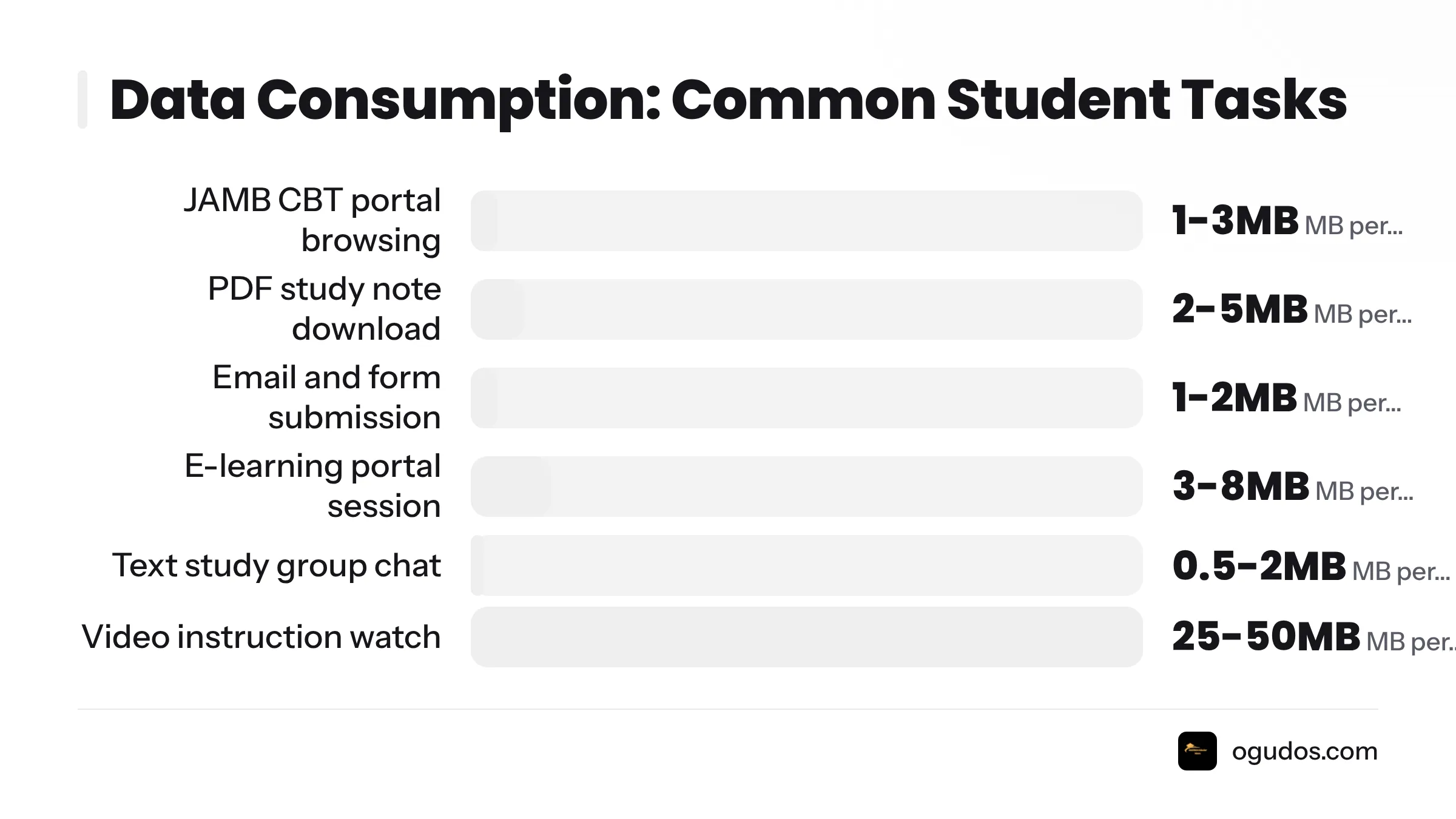
Activity | Estimated Data Used | Roughly How Many Times on 100MB |
|---|---|---|
Browsing the JAMB CBT practice portal (text-based pages) | 1 to 3MB per session | 30 to 50 sessions |
Reading or downloading a 20-page PDF study note | 2 to 5MB | 20 to 30 downloads |
Checking email and submitting a scholarship application form | 1 to 2MB | 50+ times |
Browsing a university e-learning portal (text and light images) | 3 to 8MB per session | 12 to 30 sessions |
A WhatsApp text-based study group chat session (excluding media) | 0.5 to 2MB per 30 minutes | Several hours of chatting |
Watching a 5-minute instructional video | 25 to 50MB | 2 to 4 videos (will likely exceed free allocation quickly) |
If you stick to reading, form submissions, and light portal browsing, 100MB a day can support focused JAMB revision or scholarship research without touching your paid bundle. If your study depends on video lectures, you will burn through the allocation fast. Plan to download lecture videos on Wi-Fi where possible and reserve your free daily data for text-based tasks.
Is This Legitimate? Protecting Yourself from Scams
Yes, the Free Daily Data Initiative is a legitimate Federal Government programme, implemented through the NCC in coordination with national telecom operators. The same qualities that make it attractive - it is free, government-branded, and widely discussed - make it a prime target for scammers. Being skeptical is smart.
How to Verify Official Information
Check the NCC's official website directly for press releases and framework documents.
Call or visit your network provider's official customer care line, the same number on your SIM pack or on their verified website.
Cross-reference news coverage with established national outlets rather than relying on unverified social media posts.
Watch official briefings, such as the NCC's explainer on the zero-rated access framework, for the clearest first-hand description.
Red Flags to Watch For
Anyone asking you to pay airtime, a card PIN, or a "processing fee" to activate free data
Links sent via WhatsApp or SMS from unknown numbers claiming to be "the official FG data portal"
Promises of data amounts larger than the officially stated 100MB daily cap
Pressure to act "within the next hour" or lose eligibility - a classic urgency scam tactic
Requests for your NIN, BVN, or banking details in exchange for data access
If something feels off, it almost certainly is. Government-backed, free, zero-rated data will never require you to send money or sensitive personal information to a stranger.
How This Initiative Compares to Past Student Data Programmes
Nigeria has tried free or discounted education data before, mostly through individual telecom promotions rather than unified federal policy. Here is how this initiative stands out.
Programme | Who Ran It | Data Offered | Scope | Permanence |
|---|---|---|---|---|
Free Daily Data Initiative (2026) | Federal Government via NCC, with telecom partners | Up to 100MB daily, zero-rated | Nationwide, education-platform specific | Ongoing federal policy, not time-limited |
Past NCC zero-rating pilots | NCC, limited operator trials | Varied, typically smaller or regional | Pilot regions only | Time-limited trials |
MTN/Airtel education data promos | Individual telecom operators | Varied discounted bundles | Subscriber-specific, often paid add-ons | Promotional, subject to expiry |
FG teacher data empowerment initiative | Federal Government | Free data allocation for teachers | Targeted at educators | Separate initiative, teacher-focused |
The 2026 initiative stands out because of its coordinated, nationwide, student-specific design. For context on the broader pattern of digital-access policy, Channels Television's coverage of the teacher-focused data empowerment initiative is worth watching.
What to Do If Your Free Data Is Not Working
If you have confirmed basic eligibility but the free 100MB still is not showing up, work through this checklist:
Confirm your NIN-SIM linkage. An unlinked or improperly registered SIM is the most common reason a zero-rated service fails to activate. Dial your network's NIN verification code to double-check.
Check for a rollout delay in your area. National rollouts rarely activate everywhere on day one. Wait a few days after the official start date and check again.
Confirm you are visiting an approved platform. If the webpage you are testing is not on the whitelist, your main balance will be charged - a signal the service is working as designed, just not for that site.
Restart your device and toggle airplane mode. A simple network refresh sometimes resolves a data session not registering the zero-rated allocation.
Contact your network's official customer care. Each operator has dedicated support lines and verified social media handles. Avoid third-party "fixer" accounts.
Report persistent issues to the NCC. The regulator maintains consumer complaint channels through their official website.
Making the Most of Your Free 100MB Daily
Over a decade of mentoring Nigerian students through JAMB prep, scholarship applications, and digital skills training, I have watched learners stretch tiny data bundles further than seemed possible. These principles apply here:
Download, do not stream. Save PDFs and study notes for offline reading instead of repeatedly reloading the same page.
Turn off auto-play and background data. Many apps quietly consume data in the background; disabling this on educational apps keeps your 100MB focused on what matters.
Prioritize your highest-value task first. If you only have 100MB, spend it on submitting your JAMB registration or scholarship form before browsing less urgent material.
Use browser data-saver modes. Most mobile browsers, including Chrome and Opera Mini, offer a "lite" or "data saver" setting that compresses pages, stretching your allocation significantly.
Batch your study sessions. Instead of checking a portal five times a day, plan one focused session to minimize repeated page loads.
Pair free data with free Wi-Fi where available. Use your free 100MB for urgent portal access during the day and save heavier downloads for free Wi-Fi spots, such as a school library or computer lab.
I once mentored a student preparing for JAMB who had less than 200 naira of data credit most weeks. She built a habit of downloading past questions as PDFs overnight on borrowed Wi-Fi, then reviewing them completely offline, reserving her paid data strictly for submitting CBT practice results. That same discipline, applied to a reliable 100MB daily allocation, can carry a focused student through an entire admission season without data-related panic.
For practical guidance on stretching Nigerian mobile data further, this video on getting more data for less money in 2026 covers habits that complement the free daily allocation.
Frequently Asked Questions
What exactly is the Free Daily Data Initiative for Nigerian students?
It is a Federal Government programme run through the NCC that gives eligible Nigerian students up to 100MB of zero-rated data every day, reserved for accessing approved educational platforms, without affecting their regular paid data bundle.
Who announced the free 100MB daily data programme?
The Federal Government announced it through the Nigerian Communications Commission, coordinating with the Federal Ministry of Communications, Innovation and Digital Economy. National news outlets reported the announcement in the weeks before launch.
When did the initiative officially start?
October 1, 2026, as confirmed across multiple news reports, though rollout to individual networks and regions may follow in phases.
Who is eligible to receive the free 100MB daily data?
Eligibility generally targets verified Nigerian students, including secondary school learners, undergraduates, polytechnic and college of education students, and NYSC corps members in SAED training. Full official criteria should be confirmed through your institution or network.
Do I need to be enrolled in a specific type of institution to qualify?
You generally need to be enrolled in a recognized Nigerian educational institution, though the exact list of qualifying institution types is still being clarified by the implementing bodies.
How do I register or activate my free daily data?
Confirm your SIM is NIN-linked and active on a participating network, watch for an SMS, app, or USSD notification from your provider, then access an approved educational platform to confirm the allocation is working.
Is there a USSD code to activate the free data?
No single nationwide USSD code had been officially published across all networks at the time of writing. Always verify any code through your network's official customer care channel before dialing it.
Which telecom networks support the Free Daily Data Initiative?
The programme is expected to roll out across Nigeria's major operators, including MTN Nigeria, Airtel Nigeria, Globacom, and 9mobile, though confirmed participation and timing can vary by provider.
Does the free data work on all SIM cards, or only NIN-linked lines?
It is expected to require a SIM that is properly registered and linked to your National Identification Number, consistent with existing NCC SIM registration policy.
What can I actually use the free 100MB for?
The allocation is intended strictly for accessing designated educational platforms and content, such as JAMB portals, university e-learning systems, and NYSC SAED modules, not for general browsing or entertainment.
Are social media apps like WhatsApp or Instagram included in the free data?
Most zero-rating frameworks exclude general social media and messaging apps by default, so you should assume WhatsApp, Instagram, and similar apps are not covered unless your network explicitly confirms otherwise.
Which educational platforms are approved under this initiative?
Expected platforms include JAMB's CBT and registration portals, university and polytechnic e-learning systems, NYSC SAED training modules, and government-backed digital learning resources, pending the full official whitelist.
Does the 100MB reset every day, or can it roll over?
It resets every 24 hours and does not roll over, so unused data from one day does not carry forward to the next.
What happens if I don't use my free data for the day?
It simply expires and is replaced by a fresh 100MB allocation the next day. There is no accumulation or banking of unused data.
Is the Free Daily Data Initiative permanent, or a limited-time programme?
It has been described as an ongoing federal policy rather than a short-term promotional offer. Students should watch for official updates confirming its long-term continuation.
Is this offer legitimate, or could it be a scam?
The initiative itself is a legitimate Federal Government and NCC-backed programme, but scammers may try to exploit public interest, so always verify activation steps through official NCC or network channels.
How can I verify official information about the initiative?
Check the NCC's official website, contact your network's verified customer care line, and cross-reference claims with established national news coverage rather than unverified social posts.
What should I do if my free data doesn't activate?
Confirm your NIN-SIM linkage, check whether your region has received the rollout yet, verify you are using an approved platform, and contact your network's official support if the issue persists.
Can NYSC corps members or SAED participants benefit from this initiative?
Yes, NYSC corps members engaged in SAED digital training modules are expected to be among the eligible categories, given the programme's education-access focus.
How far can 100MB actually go for studying or research?
For text-based tasks like portal browsing, PDF downloads, and form submissions, 100MB can realistically support 20 to 50 sessions a day. Video content will consume the allocation much faster.
Are there similar free-data programmes that existed before this one?
Yes, the NCC has run smaller zero-rating pilots before, and individual telecom operators have offered discounted education data bundles, though none matched this initiative's coordinated, nationwide scale.
Will there be penalties for misusing the free data?
Official penalty details have not been widely published, but using zero-rated data outside its approved educational scope will typically draw from your regular paid bundle instead, rather than triggering a formal penalty.
Can university, polytechnic, and secondary school students all access it?
Yes, based on how the initiative has been described, students across secondary, university, polytechnic, and college of education levels are expected to be covered, subject to confirmed eligibility verification.
Where can I get help if I have issues with my free data?
Start with your network's official customer care line, then escalate to the NCC's consumer complaint channels if the issue remains unresolved.
How does this initiative compare to telecom operators' own student data plans?
Unlike operator-specific paid or promotional student bundles, this initiative is free, government-coordinated, and designed specifically for zero-rated access to approved educational platforms across participating networks nationwide.
What This Means for Nigerian Students in 2026
Strip away the scattered headlines, and what remains is a genuinely practical opportunity: a free, government-backed data allocation designed to remove one of the biggest obstacles Nigerian students face. It will not replace your main data plan or stream your favorite shows, but used well, it can carry your JAMB prep, NYSC SAED modules, and scholarship research further than you might expect.
My advice, after years of helping students squeeze maximum value from limited resources, is straightforward: verify your eligibility through official channels, protect yourself from anyone asking for money to activate something supposed to be free, and build daily habits that put your 100MB toward the tasks that move your education forward.
For more practical guidance on building the digital skills and academic strategies that make resources like this count, explore the mentoring resources available through Ogudos Scholars. This article will be revisited and updated as the Federal Government and NCC release further official details, so check back for the latest confirmed information.


Comments
Post a Comment