
After a decade of reviewing academic certificates - checking WAEC results for student admissions, evaluating degrees for new hires, and inspecting documents that simply "feel off" - I can offer you a direct answer: spot a forged Nigerian certificate by examining the paper and print quality, cross-checking names and dates for consistency, confirming the serial number and security features match what the issuing body uses, and treating anything suspicious as a reason to contact the issuer directly. Visual inspection alone never provides final proof.
This last point matters more than any single red flag. A well-made forgery can look almost perfect. A genuine certificate can have a smudge or slightly unusual font. What you need is not a gut feeling but a repeatable process.
Why Fake Certificate Cases Are Growing in Nigeria
Credential fraud in Nigeria is not new, but it has become easier to attempt and harder to catch at first glance. The West African Examinations Council regularly cancels results linked to examination malpractice and forged records during each release cycle, as documented in WAEC's official result statements and communications through the West African Examinations Council Nigeria. Universities and employers have responded by requiring direct verification through official channels, partly because paper-only checks were missing too many fakes.
Two factors have shifted the risk picture. First, affordable scanning, printing, and photo-editing software means a forger no longer needs a printing press - a decent desktop setup and patience produce a convincing fake. Second, employers and schools now treat document screening as a core hiring and admissions requirement rather than a rare precaution, which has pushed credential fraud from scandal to routine due diligence concern.
This does not mean every unusual-looking certificate is fake. It means you need a way to separate ordinary printing variation from genuine warning signs - exactly what the rest of this guide provides.
Examine the Paper and Physical Material
Before reading a single word, handle the certificate. Paper reveals more than most people expect.
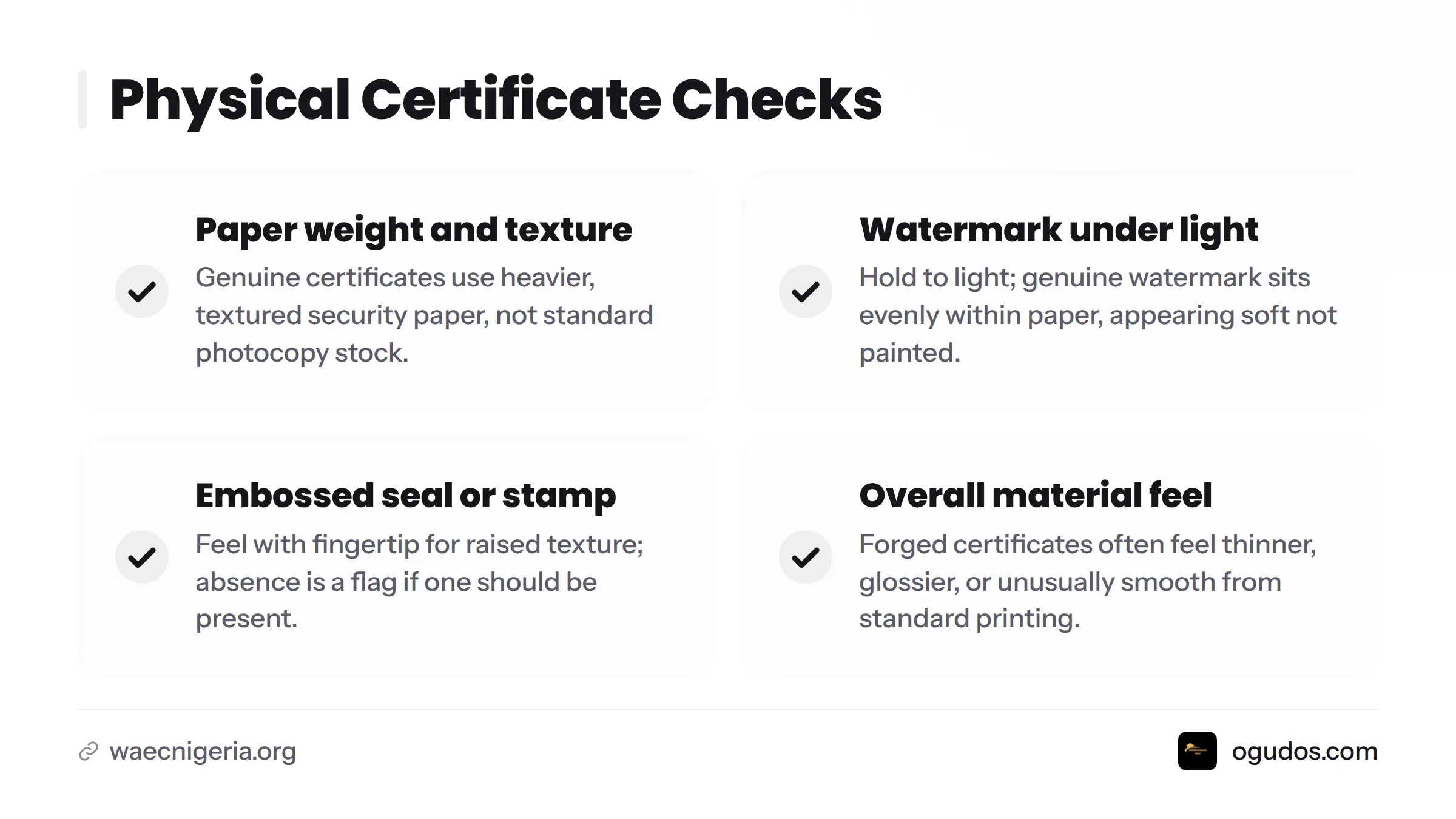
Paper weight, texture and feel
Genuine WAEC, NECO, and university certificates are printed on noticeably heavier, slightly textured security paper - not standard photocopy or printer stock. A forged certificate printed at a local business center often feels thinner, glossier, or unusually smooth because it went through a standard inkjet or laser printer rather than the issuer's specialized equipment.
Watermark presence and clarity
A watermark is a faint design built into the paper itself, visible mainly when you hold it to light. It is one of the hardest security features to copy convincingly. On a genuine certificate, the watermark sits evenly within the paper and looks soft, not painted on as a flat gray pattern. If you see a watermark that appears to be painted, smudged, or oddly off-center, that warrants closer inspection.
Embossed stamp or raised seal
Many Nigerian certificates carry a raised embossed seal you can actually feel with your fingertip, not just see. Run your finger lightly over the seal area. If there is no raised texture on a certificate type that should have one, note it as a flag.
Quick paper test: Hold the certificate against a window or bright lamp and look for the watermark. Run a fingertip over the seal or stamp area to feel for embossing. Both checks take under thirty seconds and require no special equipment.
Inspect the Print Quality and Layout
Once you have felt the paper, look at how the document was actually printed.
Font consistency across the document
Genuine certificates come from a single template, so the typeface should look identical throughout - same weight, spacing, and numeral style. A classic forgery signal is a name or date typed in a noticeably different font from the surrounding text, often because the forger edited a scanned template rather than recreating the original document from scratch.
Alignment, spacing, and margin errors
Examine how text sits within boxes or lines. Official templates are proofed and printed in bulk, so margins, line spacing, and text alignment tend to be precise. Crooked text, uneven spacing between words, or information that spills outside its intended field suggests manual editing.
Blurred or pixelated seals and logos
Institutional logos and seals on a genuine certificate are typically sharp, whether printed or stamped. A logo that appears blurry, pixelated, or low-resolution usually means it was copied from a scanned or downloaded image rather than printed from an original digital file - a common shortcut in low-effort forgeries.
Color and ink quality
Ink color should be consistent and even across the page. Patchy ink, color that looks faded in spots and dark in others on a certificate claimed to be recently issued, or colors that seem slightly "off" compared to a known genuine sample are worth flagging, though not conclusive on their own.
Cross-Check Details: Names, Dates, Grades, and Signatures
This is where document review becomes genuinely diagnostic, because details are harder to fake consistently than paper or print quality.
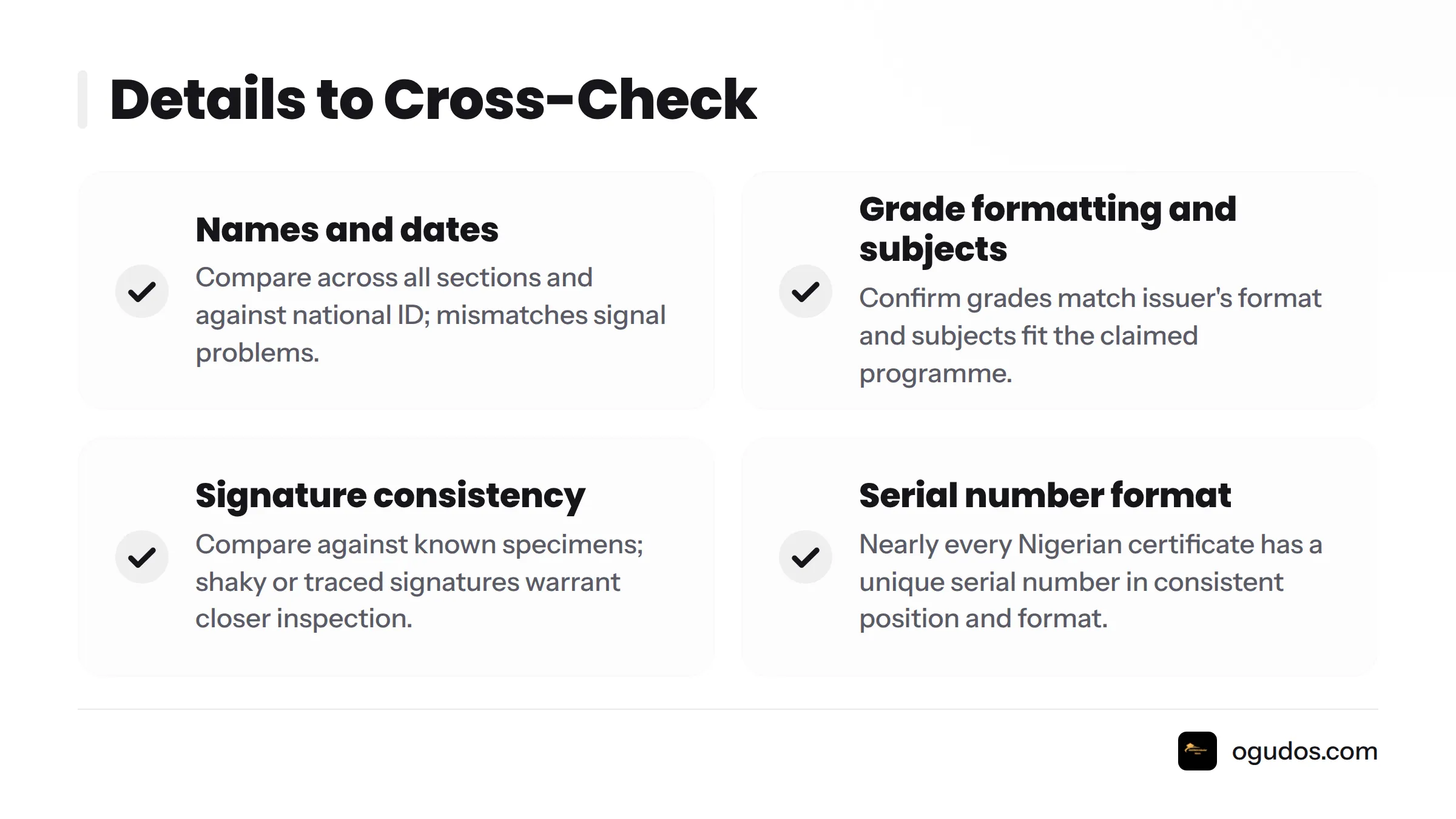
Names and dates for internal consistency
Compare the name, date of birth, and examination or graduation year across every section of the certificate, and against any other identity document the person has provided. A mismatch between the certificate and a national ID, or an exam date that does not align with the candidate's stated age, is a strong signal something needs explaining.
Grade formatting and subject combinations
Check that grades match how the issuing body actually formats them, and that the subject combination fits the claimed programme or class of study. Unusual subject pairings, non-standard grade symbols, or a disproportionate number of distinctions compared to the rest of the record deserve a second look.
Signature comparison against known specimens
Registrars, exam controllers, and vice-chancellors sign in a particular, fairly consistent way across genuine certificates issued around the same period. A signature that looks shaky, traced, or structurally different from known specimens is one of the more reliable physical clues - though you should never rely on signature comparison alone to make a final decision.
Certificate serial number presence and format
Nearly every legitimate Nigerian academic certificate carries a unique serial number, usually printed in a consistent format and position. A missing serial number, one that looks hand-added, or a format that does not match other genuine certificates from the same institution and year is a meaningful flag.
Verify the Issuing Institution and Security Features
Hologram and security seal verification
Holograms and security seals are designed to resist casual copying - they shift color or pattern depending on your viewing angle. Tilt the certificate under light and watch for that shift. A hologram that looks like a flat printed sticker with no change in appearance as you tilt it is a strong warning sign.
Known security features of WAEC, NECO, and degree certificates
WAEC and NECO have reinforced their certificate security measures and verification channels as part of efforts to curb examination malpractice, as confirmed through official communications from the West African Examinations Council Nigeria and the National Examinations Council (NECO). Nigerian universities, following standards set by the National Universities Commission, typically issue degree certificates bearing the institution's seal, registrar's signature, and a unique certificate number tied to the graduate's academic record at the registry.
Side-by-side comparison with a genuine sample
If you have legitimate access to a genuine certificate from the same institution, year, or batch, comparing layout, font, seal placement, and paper quality side by side is one of the fastest ways to spot deviations. Employers who screen repeatedly for the same institution should keep a reference copy on file for this purpose.
Warning Signals That Need Further Investigation
Some issues are worth noting but do not, by themselves, prove forgery. Printing runs vary, paper ages differently, and scanning quality depends on how a copy was made. Treat these as reasons to look closer, not grounds for rejection.
Warning Signal | Why It's Not Conclusive Alone |
|---|---|
Slightly faded or uneven ink | Older certificates fade naturally with storage and handling |
Minor font-size variation between sections | Some genuine templates were updated across different print years |
Poor photocopy or scan quality | A poor copy of a genuine original still looks wrong without being fake |
Paper looks a slightly different shade | Paper stock batches vary slightly between print runs |
Seal placement slightly off from previous samples | Minor template adjustments occur between issuing cycles |
Red Flags That Require Issuer Confirmation
When you encounter these issues, visual judgment must stop and formal verification must start. Do not make a final decision yourself - escalate to the issuing body.
Red Flag | What It Signals |
|---|---|
Missing or malformed serial number | Possible template copy with no genuine record |
Signature structurally different from known specimens | Possible forged or unauthorized signatory |
No raised embossing where one is expected | Possible use of a flat scan or printed copy, not an original |
Hologram that does not shift color or pattern under light | Possible printed sticker replacing a real security hologram |
Names, dates, or grades inconsistent with the person's other records | Possible tampering with an otherwise genuine template |
Institution has no record of the certificate number on file | Confirms forgery once verified through official channels |
That last row is the entire point. A clean visual check is reassuring, but it is not verification. Only the issuing institution can confirm a certificate actually exists in their records under that name with that result.
What to Do If You Suspect a Fake Certificate
Here is the core process as a checklist you can complete in minutes:
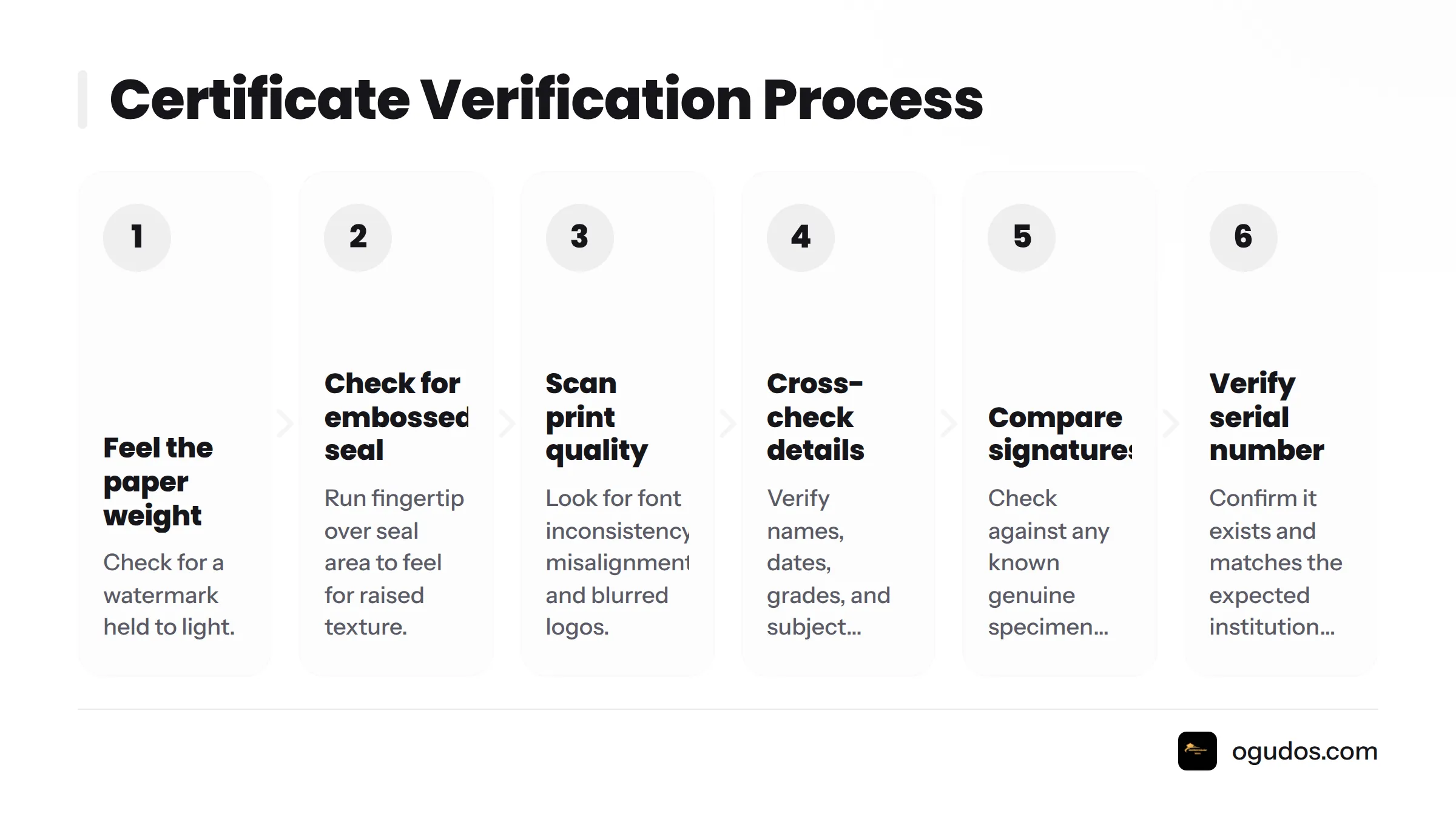
Feel the paper weight and check for a watermark held to light.
Check for a raised, embossed seal.
Scan the print for font inconsistency, misalignment, and blurred logos.
Cross-check names, dates, grades, and subject combinations for consistency.
Compare the signature against any known genuine specimen.
Confirm a serial number exists and matches the expected format.
Tilt any hologram or security seal under light to check for genuine color shift.
If anything in the confirmation-required category appears, stop guessing and verify with the issuer.
Once you reach step eight, your next move depends on the certificate type. For government-recognized qualifications, use the FG verification portal, which lets employers, schools, and individuals confirm certificates against official records. For university qualifications, contact the university registry directly. For secondary school results, the process differs depending on whether you are verifying a WAEC certificate or NECO certificate, since each body runs its own verification channel.
Resist making a final decision on visual inspection alone, even after running every check on this list. I have seen well-meaning HR staff reject a genuine certificate because the paper felt thin from years of storage, and I have seen a convincing fake pass casual review because the forger got the font right. The checklist narrows your uncertainty. The issuer confirms it.
Signature analysis offers useful clues, and watching how a trained eye compares genuine and questioned signatures side by side helps you recognize structural differences that are harder to judge without practice.
Frequently Asked Questions
What is a fake or forged certificate?
A fake or forged certificate is a document presented as an official academic qualification that was not genuinely issued by the named institution. It may be created entirely from scratch, copied from a real template and altered, or issued through a fraudulent process disguised as legitimate. The distinction matters: a "fake" certificate may be invented from nothing, while a "forged" certificate often started as a genuine template that someone altered - for example, changing a grade or name on an otherwise real document.
Can a fake certificate look completely genuine?
Yes. A well-made forgery can pass casual visual inspection, especially with modern scanning and printing tools. This is exactly why visual red flags should prompt further checking rather than a final verdict, and why confirmation with the issuing institution remains the only reliable proof of authenticity.
What happens if you are caught with a fake certificate?
Consequences typically include disqualification from the role, admission, or examination in question, and can extend to criminal prosecution depending on the circumstances and the institution's policy, since presenting a forged academic document is treated as fraud under Nigerian law. Specific penalties and procedures vary by case and are outside the scope of this guide.
Is it illegal to fake a certificate in Nigeria?
Yes, forging an academic certificate or knowingly presenting a forged certificate is a criminal offense in Nigeria, generally prosecuted under forgery provisions of the Nigerian Criminal Code or Penal Code depending on jurisdiction. For specific legal guidance, consult a qualified legal practitioner rather than relying on general articles.
Can employers detect fake certificates during screening?
Employers can catch many fake certificates by combining the visual and detail checks in this guide with direct confirmation through the issuing institution or an official verification portal, which is the only step that provides certainty. Many organizations now build this confirmation step into standard employer due diligence for every new hire rather than treating it as optional.
Are holograms enough proof that a certificate is genuine?
No. A hologram is one useful security feature among several, not standalone proof. Forgers increasingly attempt to mimic holograms with printed stickers, so a hologram that looks right should still be paired with the other checks in this guide and, where in doubt, issuer confirmation.
What should I do first if I suspect my own certificate was issued incorrectly?
Contact the issuing institution's registry or examination body directly to request a review of your record, rather than attempting to alter the document yourself, which could expose you to a forgery accusation even if your original intent was simply to correct an error. Keep copies of your original documents and any correspondence throughout the process.


Comments
Post a Comment