
Every Nigerian student asks the same question at some point, usually late at night while scrolling job sites: can I actually freelance without experience, a portfolio, or money to invest?
The answer is yes. You need a skill you can deliver, a working device, stable internet, a way to receive payments, and about three to five hours a week. The path breaks into six concrete steps: pick one service, build a simple portfolio, choose a platform for gigs, write pitches that get replies, price the work correctly, and deliver in a way that leads to the next client.
I have spent the better part of ten years helping Nigerian students land their first paid freelance gigs. The pattern repeats every semester. The students who get clients fastest are not always the most talented. They are the ones who follow a logical sequence instead of trying everything at once. This guide maps that sequence the way I actually walk students through it.
What Freelancing Is, and What It Actually Requires
Freelancing is project-based, independent work you deliver remotely for clients who pay per task or contract, not per month. You are not employed. Instead, you are hired repeatedly by different people for specific outcomes: a written article, a logo design, a cleaned spreadsheet, an Instagram caption calendar, tutoring in a subject.
What surprises students is what freelancing does not require. You do not need a university degree in your field, a registered business name, or savings to "invest" before starting. Nigeria's labour market is overwhelmingly informal and increasingly digital, which partly explains why remote, platform-based work has become a viable side income for students without formal work history (National Bureau of Statistics, Nigeria Labour Force Statistics). What freelancing actually requires is much narrower:
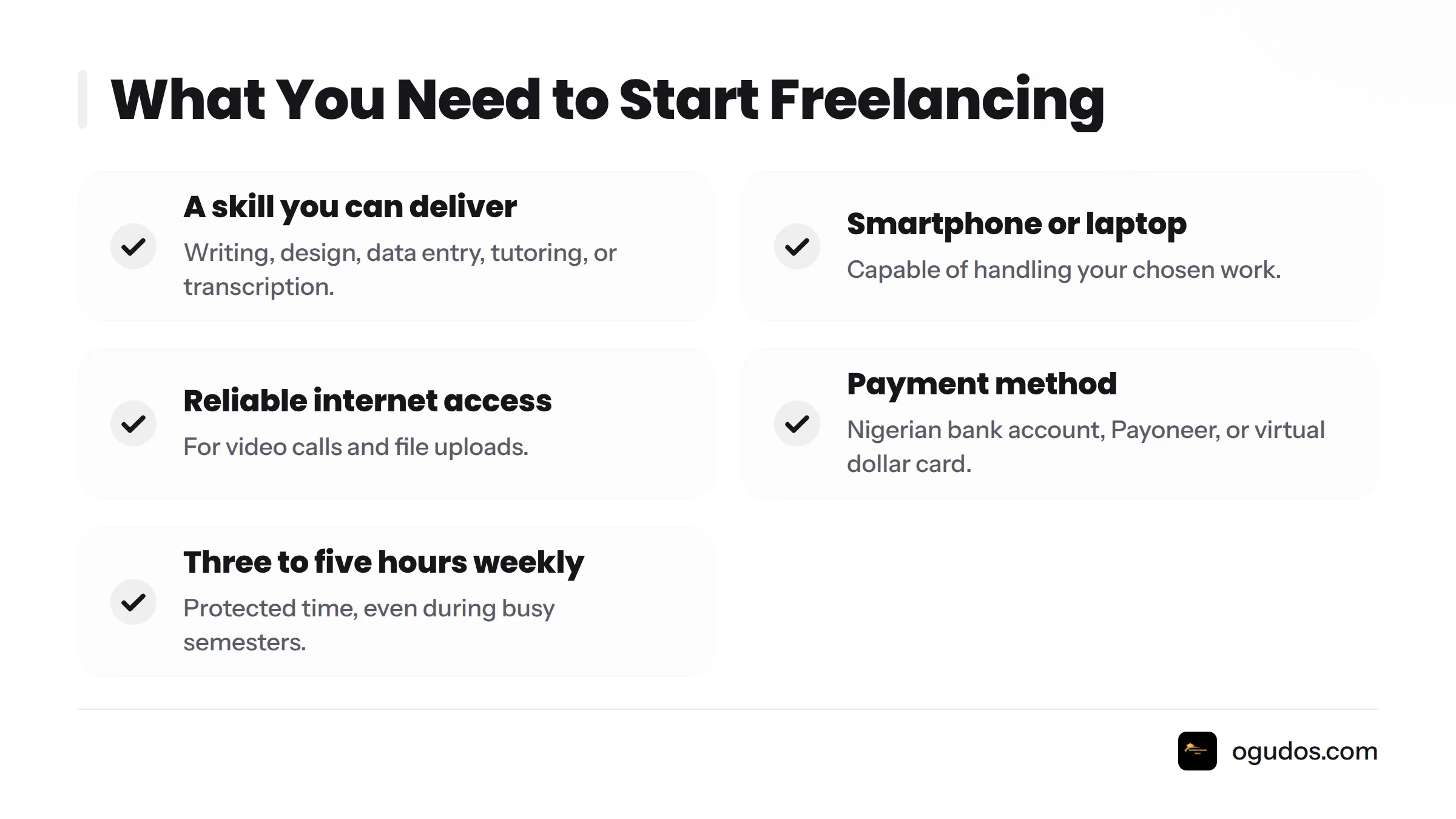
Before you start, you need:
A skill you can already deliver (writing, basic design, data entry, tutoring, transcription, social media scheduling)
A smartphone or laptop capable of handling the work
Reliable internet access for video calls and file uploads
A payment method that accepts foreign or local currency (a Nigerian bank account at minimum; Payoneer or a virtual dollar card if you plan to work on global platforms)
Three to five hours per week you can protect, even during busy semesters
Notice that "experience" is not on this list. Clients buying a first-time freelancer are not hiring a resume. They are buying proof that you can solve one specific problem. Step 2 builds that proof.
Step 1: Pick One Service You Can Deliver This Week
The biggest reason students stall is choosing between seven possible skills instead of committing to one. Here is the filter I use with every student: pick the service you could deliver this week, using only what you already know, with zero additional learning.
Ask yourself three questions:
What have I already done for free - for a church group, a class project, a friend's business, or a student union page - that someone else found valuable?
What is the smallest version of that skill I could sell as a single deliverable (one blog post, one poster, one spreadsheet, one tutoring session) rather than an ongoing retainer?
Can I finish that deliverable in a weekend without skipping lectures?
Common starter services for Nigerian students include content writing, proofreading and editing, basic graphic design (flyers, social posts), data entry and research, virtual assistant tasks (email management, scheduling), transcription, and subject tutoring for WAEC, JAMB, or university courses. None require a certificate. All require a single finished sample.
If you genuinely have no sellable skill yet and have more than a semester to prepare, building one properly is better than faking it. The guide to high income skills to freelance with walks through which skills are realistic to learn from zero and typical timelines. But if you already have something, however small, move to Step 2 today.
Step 2: Build a Simple Portfolio Without Prior Clients
This is where most guides go quiet. "Build a portfolio" is easy to say and hard to do when you have never been paid for anything. Here is what actually works.
Your first portfolio needs three things:
One to three finished samples, even if nobody paid for them. If you write, write a sample article on a topic a real client would care about. If you design, create a mock flyer for a realistic fictional business. If you tutor, record a two-minute video of you teaching one concept clearly.
A short description of the problem each sample solves. A client reviewing your portfolio in 30 seconds should understand in one sentence what you were asked to do and what you delivered.
A way to review it in under 30 seconds. A shared Google Doc, a free Canva one-pager, or a simple Notion page all work. You do not need a custom website.
This is the "spec work" approach: creating demonstration samples that prove capability without prior client history. It is standard and accepted in creative and service freelancing, as long as you are upfront that the sample is a demonstration piece, not client work. Coursework counts too. A university assignment you led, a group project report, or a social media calendar you built for your class association are all legitimate proof of skill.
One more honest option: your first one or two real gigs can be offered at a discounted rate specifically to generate a genuine client testimonial and a real deliverable for your portfolio. Treat this as a deliberate short-term bridge, not your pricing strategy going forward.
Step 3: Choose Where to Find Your First Gigs
Different platforms suit different starting points. Your choice depends on whether you want global clients paying in dollars or local clients you can reach through your existing network.
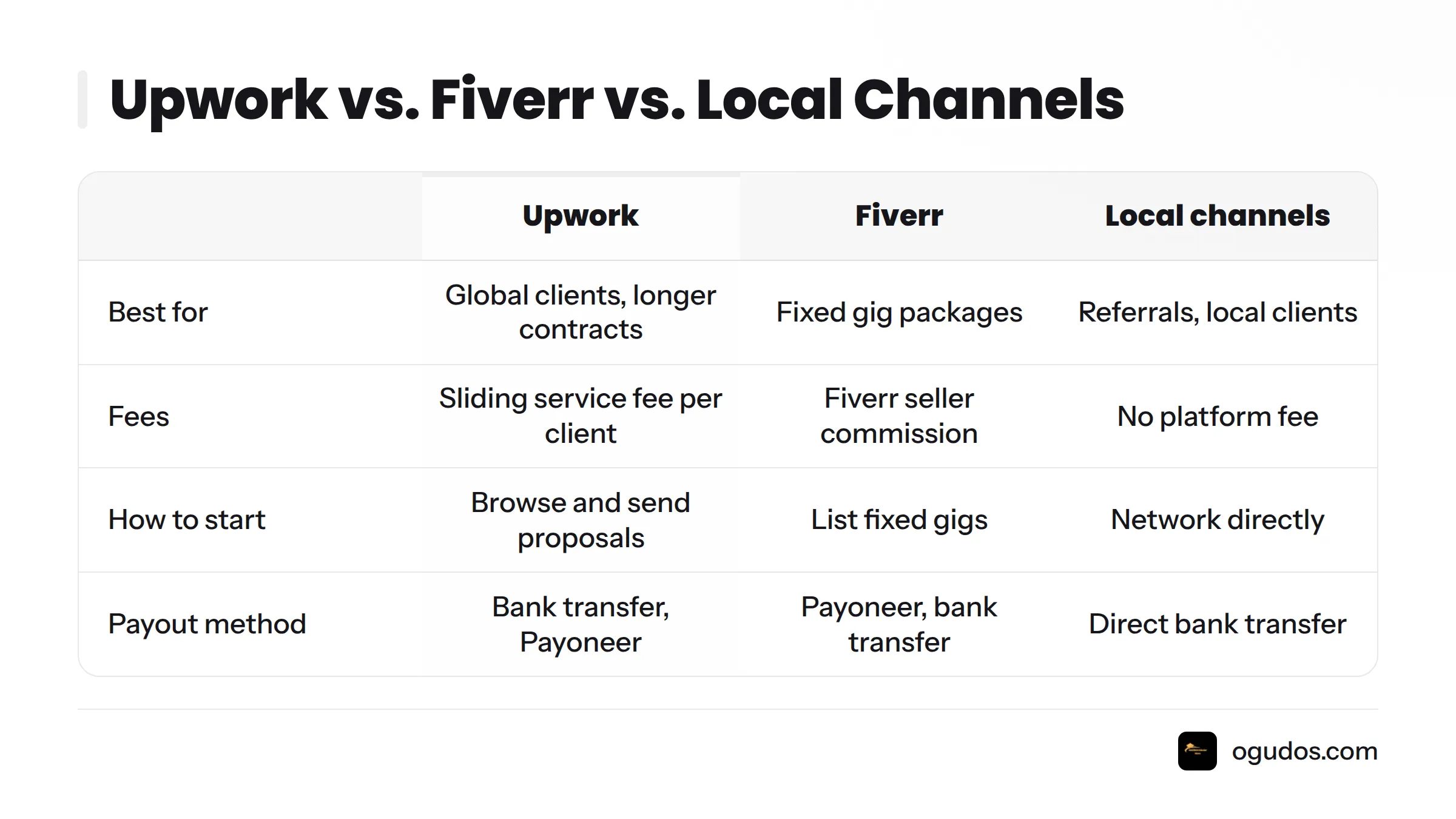
Platform | Best for | What Nigerian students should know about fees | How payouts work |
|---|---|---|---|
Upwork | Writing, design, web development, admin work, tutoring, finding clients around the world, and getting longer-term jobs | Upwork charges freelancers a service fee. The fee can go down as you earn more from the same client. See Upwork's service fee page. | You can withdraw your money through direct bank transfer, Payoneer, or wire transfer. Your account must be approved before you can send job proposals. |
Fiverr | Selling ready-made services, such as a fixed design, article, or tutoring package | Fiverr charges buyers a service fee. Freelancers receive the gig price minus Fiverr's commission. See Fiverr's pricing page. | Your money becomes available after a waiting period. You can then withdraw through Payoneer, direct bank transfer in supported regions, or the Fiverr Revenue Card. |
Local and social channels (LinkedIn, student WhatsApp groups, course mates, Jobberman) | Getting your first jobs, finding clients through referrals, and working with local clients who may hire you again | These channels do not charge a platform fee, but they do not provide built-in protection if a payment or work dispute occurs. | Clients pay you directly through bank transfer. You must agree on the payment terms in writing before starting the work. |
Global platforms: Upwork and Fiverr
Upwork works like a job board: you browse posted jobs and send proposals. Fiverr flips that model: you list fixed "gigs" (for example, "I will write a 500-word SEO blog post") and clients come to you. For a complete beginner with no reviews, Fiverr's listing model feels less intimidating because you are not competing proposal-by-proposal against freelancers with hundreds of reviews. Upwork rewards a sharp proposal and can get you higher-value contracts once you have two or three reviews.
Local and social channels
Do not underestimate your own network. LinkedIn posts about your service, Nigerian student WhatsApp and Telegram groups, your department's social media page, and word of mouth through course mates often produce a first client faster than any algorithm, because some trust already exists. Jobberman and similar Nigerian job platforms also list short-term and remote gigs worth checking.
This first-hand account from a Nigerian student landing remote work captures the mix of platform hunting and networking that usually produces the first client.
Step 4: Write a Pitch That Gets Replies
A pitch (or proposal on Upwork, buyer request response on Fiverr) is the single highest-leverage five minutes of your entire start. Most beginner pitches fail not because the student lacks skill, but because the pitch reads like a job application instead of a solution to one problem.
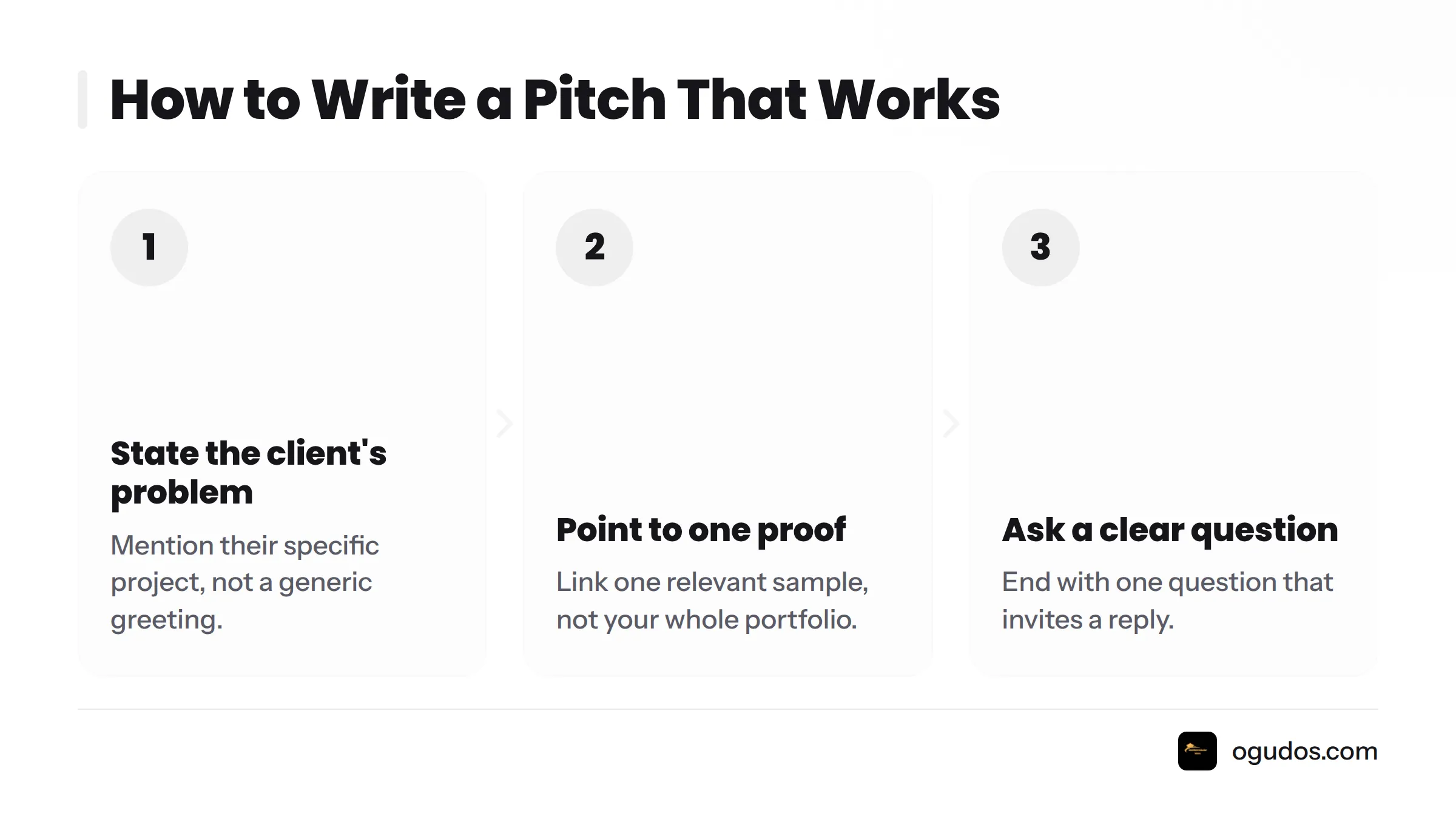
A strong pitch does three things in under 100 words: states the client's actual problem in your own words, points to one piece of proof you can solve it, and asks a clear question that invites a reply.
Here is an anonymized example close to one that worked for a student I mentored, applying for a blog-writing gig at a Nigerian fintech startup:
"Hi [Name], I read your post about needing weekly blog content explaining savings products in simple English for first-time users. I've written explainer content on financial literacy for my university's economics blog; here's a sample:. I can turn around a 600-word draft within 48 hours for your review. Would a short call this week work to confirm the first topic?"
Notice what it avoids: no "Dear Sir/Ma, I am a dedicated and hardworking student." No listing five unrelated skills. No asking "Is this job still available?" as the only point.
Before you send, check:
Did I mention the client's specific project, not a generic greeting?
Did I link one relevant sample, not my whole portfolio?
Did I state a realistic turnaround time?
Is the whole message under 150 words?
Did I end with one question, not three?
Step 5: Price Your First Job and Agree on Terms
Pricing your first job is less about hitting a "correct" number and more about pricing with confidence and clarity. A clearly stated price with defined scope reads professional, even from someone with zero reviews. A vague price, or one followed by nervous qualifiers, signals inexperience.
Think about pricing in three layers: what the deliverable is worth to the client, what comparable beginner gigs charge on your chosen platform, and what you need to feel the work was worth your time. Resist pricing at zero to "get started." Free work rarely converts to paid work and trains clients to expect it. A modest, clearly justified beginner rate, explicitly framed as introductory, does more for your future pricing than working for nothing.
Before you start any paid work, settle these points:
What exactly is included in the deliverable, and what is explicitly not?
When is it due, and does that conflict with your academic calendar?
How many rounds of revision are included in the price?
What payment method will be used, and when does payment happen (upfront, milestones, on delivery)?
What happens if the client wants to expand scope after you start?
Get the answers in writing, even a confirmed chat message, before you begin. This one habit prevents most disputes that derail students.
Step 6: Deliver and Turn It Into the Next Job
Landing the first client is half the win. How you deliver determines whether that client becomes a repeat income source or a one-time payment.
Three habits separate students who build a client base from those who freelance once and stop:
Communicate before you're asked to. If you're on track, say so halfway through. If something will delay you, say so the moment you know, not the day it is due.
Deliver slightly ahead of deadline. Early delivery, even by a few hours, builds a reputation that outlasts any single project.
Ask for the review and the referral in one message. Once the client confirms they are happy, ask directly: "Would you mind leaving a quick review? And if you know anyone else who needs [service], I'd appreciate the introduction." Most clients say yes when asked plainly.
A rating and review on your platform profile, or a short testimonial from a direct client, turns Step 2's manufactured portfolio into a real one. From here, each new job becomes easier to price, pitch for, and deliver because you are no longer proving you can do the work. You are proving you already have.
Common Pitching and Delivery Mistakes
The same handful of mistakes repeat across years of mentoring. Here is the honest list:
Sending the same pitch to twenty jobs. Clients know. A copy-pasted proposal with no reference to their project gets ignored in seconds.
Going silent after winning the job. Students often disappear for a week while figuring out how to start. That silence loses the next contract, even if the work gets delivered eventually.
Accepting scope creep without renegotiating. "Can you also just add..." is how one blog post becomes three for the original price, because you never said no or asked for more.
Missing a deadline without warning. A missed deadline with a two-day heads-up is forgivable. A missed deadline with silence is not.
Underpricing out of fear, then resenting the job. Students who price too low to "guarantee" winning often do the work resentfully, which shows in slower turnaround and weaker communication.
Never asking for the review. The single most skipped step. It costs nothing and is the fastest path to the next client.
Fitting Freelancing Around Lectures and Exams
This is the constraint most guides skip, and it is often the real reason students quit, not lack of skill or clients. The fix is not working more hours. It is working the same hours more deliberately.
Set a weekly freelance window before accepting any client work. Three to five hours is realistic: two hours midweek, the rest on a weekend. Block that time as you would a lecture, and treat client replies as part of that window rather than something you squeeze between classes.
Before accepting a deadline, check it against your academic calendar, not just general availability. If a client's deadline falls during exam week, say so upfront. A simple, confident message like "I can deliver this by [date], but I have exams the following week, so I'd want to lock that date in now" reads as professionalism. Most clients respect a stated boundary more than a missed, unexplained deadline.
When a genuine clash is unavoidable, you can renegotiate the deadline before accepting, decline the job and refer another freelancer in your network, or finish early rather than ask for an extension after the fact. Declining a job that conflicts with a major exam is not failure. Losing a client's trust by missing it is.
Frequently Asked Questions
Can a Nigerian student really start freelancing with zero capital?
Yes. The core requirements are a deliverable skill, a device, internet access, and a payment method, not startup money. Most students own a phone or laptop capable of writing, design, or admin work.
Which platform should I start on, Upwork or Fiverr?
Start on Fiverr if you want to list a fixed service and let clients come to you. Start on Upwork if you are comfortable writing strong proposals and want access to longer, higher-value contracts once you build a few reviews.
How much should I charge for my first job?
Price based on what the deliverable is worth to the client and comparable beginner rates on your platform, framed clearly as an introductory rate. Avoid free work; it rarely converts to paid work and trains clients to expect it.
What payment methods work for Nigerian freelancers?
A Nigerian bank account works for local, direct clients. For global platforms, Payoneer is widely used to receive payouts. Several Nigerian fintech apps also offer virtual dollar cards.
How do I avoid getting scammed by a fake client?
Never pay a client "processing fees" to receive payment, never share banking PINs or one-time passwords, and get scope and payment terms confirmed in writing before starting work. Prefer platform escrow (Upwork, Fiverr) over off-platform payment for your first few clients.
What should I agree on before starting any paid work?
Confirm the exact deliverable, the deadline, the number of included revisions, the payment method, and what happens if the client wants to add scope later, all before you begin, ideally in a written message.
How long does it take to land a first paying client?
There is no fixed timeline, and anyone promising a guaranteed number of days is overselling. Students who pitch consistently (several applications a week) on a chosen platform tend to land a first small gig within a few weeks.
Do I need a certificate or formal training to start?
No. Clients are buying proof you can deliver one specific outcome, not a certificate. A strong sample, even a self-made one, matters more than formal credentials for most entry-level gigs.
What if a client disappears without paying?
Document all communication, use the platform's dispute process if you worked through Upwork or Fiverr, and require partial upfront payment or platform escrow for your next client rather than direct off-platform arrangements.
Moving Forward
Freelancing is one path among several ways students generate income while studying. Treat it as skill-building side income rather than a guaranteed replacement for other plans. If the service you picked in Step 1 was design, consider building that skill properly through a structured free path rather than guessing. The same applies to digital marketing or video editing. Ogudos Scholars maintains a broader hub of free digital skills for students built around exactly that progression. The mentoring philosophy behind all of it is on the Ogudos Scholars homepage.
This guide is written by Ebuka Ogudo, who has spent ten years mentoring Nigerian students through their first paid freelance work, from service selection through first client delivery. The pitch examples and mistake patterns above come directly from that mentoring work, not from recycled job-board lists.


Comments
Post a Comment