
If you just received your NYSC call-up letter or you're already at camp wondering what "SAED" means when they announce it over the loudspeaker, here's the quick answer: the NYSC Skills Acquisition and Entrepreneurship Development programme trains corps members in vocational, digital, and business skills during orientation camp and throughout your service year, so you graduate with an actual income source beyond whatever job you find afterward.
That answers what most people search for. But if you want SAED to work for you instead of being something you sit through, you need the fuller picture: how it actually runs in camp, what happens after you leave, which trades are genuinely available, and how to pick one that builds real income. I've pulled in insights from Ebuka's decade-long experience mentoring corps members through this exact decision, because the official materials explain what SAED is but rarely show you how to use it well.
Last verified: November 2026.
What Is the NYSC Skills Acquisition and Entrepreneurship Development Programme?
The NYSC Skills Acquisition and Entrepreneurship Development (SAED) programme sits inside the National Youth Service Corps as the training arm specifically designed to give corps members a practical skill or business idea they can rely on, regardless of whether they land a conventional job after service. It operates under the NYSC Directorate of SAED, which runs two main divisions: Skills Acquisition, covering hands-on vocational and technical trades, and Entrepreneurship, which teaches planning, funding, and running a small business.
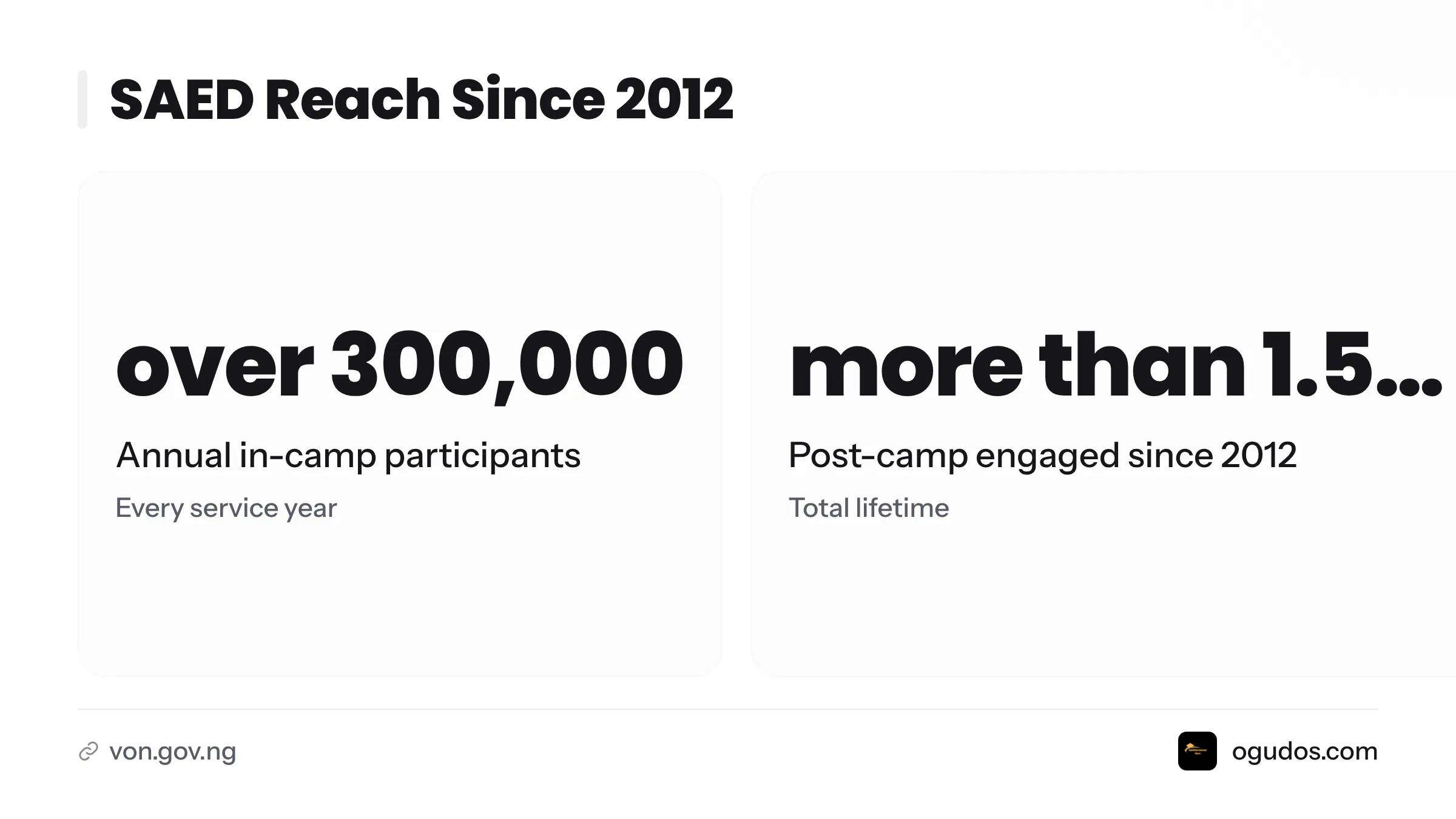
SAED is not a side activity. NYSC leadership treats it as central to the service year's purpose of converting graduate time into productivity. According to Voice of Nigeria, over 300,000 corps members pass through in-camp SAED sessions every service year, with more than 1.5 million corps members engaged in post-camp SAED training since the programme launched in 2012. NYSC's Director-General, Brigadier General Olakunle Nafiu, has highlighted the scheme's expansion, including partnerships such as the one with the National Automotive Design and Development Council (NADDC) to train corps members in vehicle CNG retrofitting. This shows SAED's trade list is growing with Nigeria's job market rather than staying locked in place.
At a Glance:
Aspect | Detail |
|---|---|
Full name | Skills Acquisition and Entrepreneurship Development |
Administered by | NYSC Directorate of SAED, with state NYSC commands running local sessions |
Starts | During the three-week orientation camp |
Continues | Throughout the 11-month service year via post-camp centres and CDS groups |
Who it's for | Every registered corps member |
Cost | Training is organised by NYSC at no extra tuition fee. Some trades may require personal contributions toward materials |
Founded | 2012 |
What Happens During SAED in Camp
Your first exposure to SAED typically happens inside orientation camp within the first week. Camp officials run a dedicated lecture explaining the divisions, available trade groups, and why the programme matters beyond the three weeks on camp grounds.
From there, you are sorted by interest into trade categories, where facilitators (often experienced vocational trainers or past corps members) run short demonstration sessions. The goal is exposure, not mastery. Three weeks cannot make you a tailor, soap maker, or web developer. What camp does is let you sample two or three trades, see what daily training actually looks like, and register your interest for the version of SAED that continues once you're posted to your Place of Primary Assignment.
These sessions run alongside drills, civic responsibility lectures, and sports, so the time per trade group often feels rushed. That's why many corps members underestimate the programme at this stage and only take it seriously after realising it continues long after the camp gates close.
How SAED Continues During Your Service Year
Here's what most corps members never fully grasp: SAED doesn't end when camp ends. It moves into two parallel tracks.
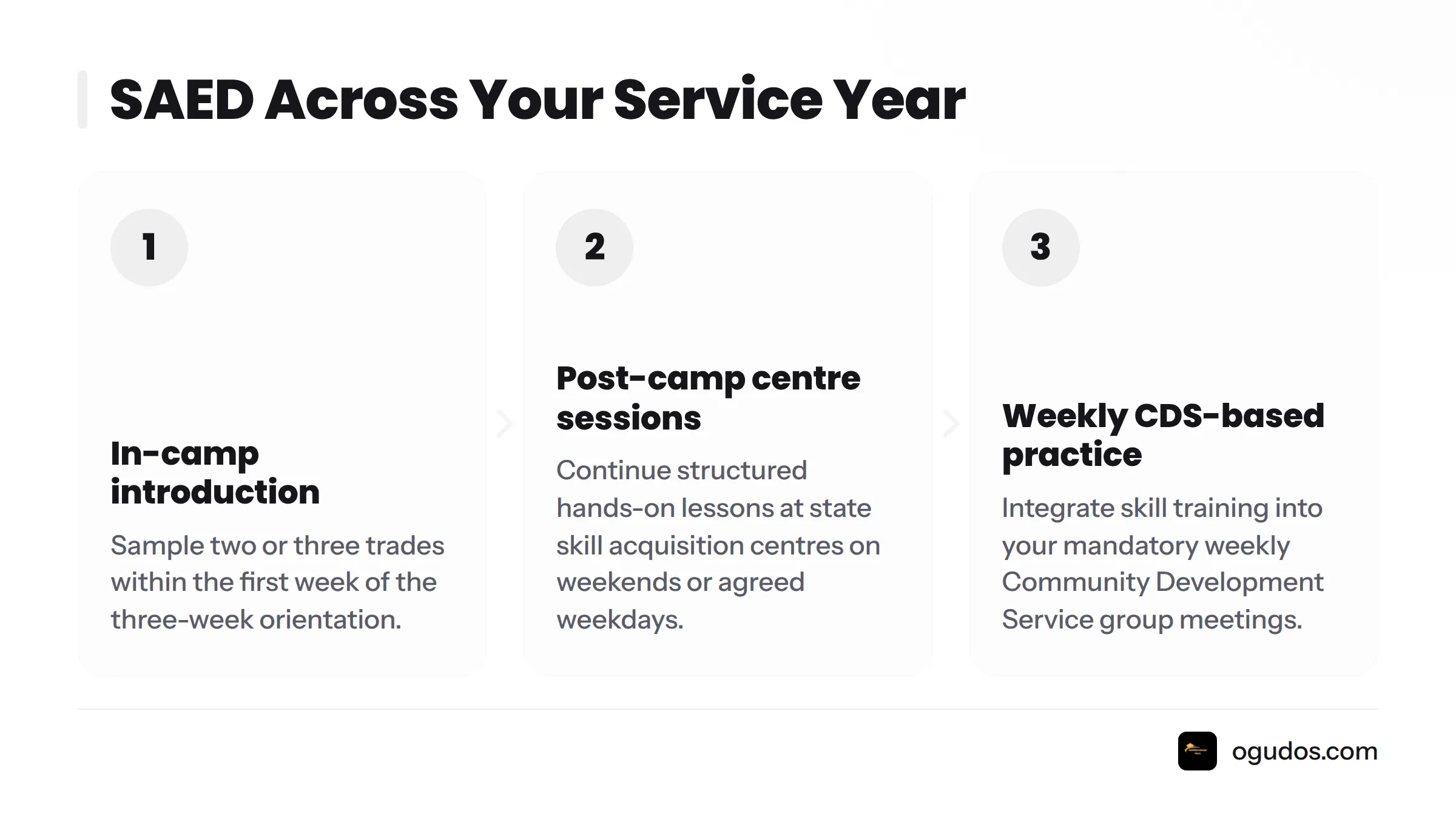
Post-camp training centres. Many states maintain a skill acquisition centre, sometimes shared with a local vocational institute or NYSC-affiliated training partner, where corps members continue structured lessons in their chosen trade. These sessions usually run on weekends or specific weekdays agreed with your Local Government Inspector, since you're expected to be at your primary assignment the rest of the week.
Community Development Service (CDS) groups. Every corps member joins a weekly CDS group as part of the service year's community-impact requirement. Many states integrate SAED into CDS by creating skill-specific CDS groups, so your weekly community service and skill training happen together. This is often the most consistent way corps members actually complete a skill, because CDS attendance is tracked and mandatory.
Side by Side:
Stage | Where | Format | Duration |
|---|---|---|---|
In-camp SAED | Orientation camp | Group demonstrations, short lectures | 1 to 2 weeks within the 3-week camp |
Post-camp SAED | State-designated skill acquisition centres | Hands-on, scheduled sessions | Spread across the 11-month service year |
CDS-based skill involvement | Weekly CDS group meeting point | Structured weekly practice, sometimes combined with group projects | Weekly, throughout service year |
If your post-camp arrangement is unclear, your Local Government Inspector or Zonal office can confirm where the nearest active centre is. Our NYSC service-year guide covers the full orientation-to-passing-out timeline in detail.
Trades and Skills Available Under SAED
SAED groups its offerings into broad categories so corps members from any academic background can find something relevant. The exact list varies by state and which facilitators and partners are active that year, but these categories are consistently represented across NYSC's published SAED structure and state command reports.
Trade Category | Example Skills | Typical Focus |
|---|---|---|
Vocational and technical trades | Fashion design and tailoring, shoemaking, soap and cosmetics production, catering | Hands-on production skills |
Agriculture and agribusiness | Poultry farming, fish farming, crop production, agro-processing | Food production and small-farm business |
ICT and digital skills | Graphic design, web development, digital marketing, computer appreciation | Tech-based, often remote-friendly skills |
Entrepreneurship and business development | Business plan writing, financial literacy, cooperative and micro-business management | Running and funding a small business |
Automotive and engineering trades | Vehicle maintenance, solar installation, CNG retrofitting under the NADDC partnership | Technical and emerging-industry skills |
Beauty and personal care | Hairdressing, makeup artistry, nail technology | Personal-service businesses |
This video from a past SAED cohort shows what the actual classroom and facilitator setup looks like:
Whether you get your first choice depends on what facilitators your camp or post-camp centre has that year. If a trade group is full or unavailable, most camps allow a documented change request, usually submitted to the SAED officials within the first few days.
How to Choose a Skill That Pays Off
I've watched too many corps members pick a SAED trade because their bunk mate did, or because the queue was shorter. Ebuka, who has mentored corps members through skill selection and early business decisions for more than a decade, says it simply: "The corps members who actually turn SAED into income are the ones who treated the choice like a real decision, not a camp activity to tick off."
His experience points to one consistent pattern. Corps members who stuck with a trade past their service year picked it for a reason connected to either an existing interest or a gap they noticed in their own community, not because it looked easy in camp.
Before you commit to a trade group, ask yourself four questions:
Do I already have a natural interest in this? Skills built on existing curiosity are far more likely to survive the grind of actual practice.
Is there visible demand for this where I'm being posted? A skill with no local market is one you'll struggle to monetise quickly.
Can I realistically practice this after service, with the tools I'll actually have? Some trades require equipment you may not afford right away.
Can this skill be combined with something digital? A tailor who markets on social media, or a caterer who takes orders online, usually outperforms one who cannot.
That last question matters more every year. Pairing a hands-on SAED skill with a digital add-on, like basic social media marketing or simple design tools, is one of the clearest ways corps members have turned a camp trade into actual side income.
Making SAED Count Before You Finish Service
Treat the months between camp and your passing-out parade as your real window to get something usable from SAED. Here's a practical sequence:
Attend consistently, not occasionally. Post-camp sessions and CDS-based skill groups only build competence through repetition. Skipping weeks is the single biggest reason corps members finish service with a certificate but no real ability.
Request a trade change early if your first pick isn't working. Most states allow this in the first few weeks of post-camp sessions, not months in.
Ask for and keep your training documentation. Many state commands issue a skill acquisition certificate or letter of participation alongside your NYSC certificate. Keep both; some employers and microfinance lenders ask for proof of vocational training.
Layer a free digital skill on top of your SAED trade. If you learned catering, pair it with basic online order-taking. If you learned tailoring, learn to photograph and post your work. Our guide to free digital skills you can monetise breaks down options.
Start practicing for real before you pass out, not after. Corps members who test their skill on a small scale (friends, family, fellow corps members) while in service get honest feedback before any money is on the line.
If you're also sorting out camp logistics or your allowance timeline, our NYSC camp items checklist and NYSC allowance explainer cover those separately.
Frequently Asked Questions About NYSC SAED
What does SAED stand for? SAED stands for Skills Acquisition and Entrepreneurship Development, the official name of NYSC's skills training initiative.
Is SAED compulsory for all corps members? Participation in the in-camp introduction to SAED is part of standard orientation camp activity for every corps member. How deeply you engage with post-camp training and CDS-based skill groups is largely up to you.
When does SAED training start during NYSC? SAED introduction begins during the three-week orientation camp, typically within the first week, and continues through post-camp centres and CDS groups for the rest of the service year.
Can I choose my own skill under SAED, or is it assigned? You generally choose from the trade groups available at your camp or post-camp centre based on your interest. Assignment by default only happens if you don't express a preference.
Can I change my SAED trade if I don't like my first choice? Yes, most camps and post-camp centres allow a documented change request, usually best done within the first few weeks before a cohort is fully settled.
Is SAED training free for corps members? NYSC organises SAED training without charging tuition, though some trades may ask corps members to contribute toward materials like fabric, tools, or ingredients.
Do I get a certificate for completing a SAED skill? Many state commands issue a skill acquisition certificate or letter of participation separate from your NYSC certificate. Ask your SAED officials what documentation is available in your state.
How can SAED help me earn income after service? SAED gives you a practical, marketable skill you can build into a small business or side income once you pass out, especially when combined with a digital skill for marketing or sales.
Before You Pick a Trade Group
SAED is one of the few parts of the service year that is genuinely yours to shape. Camp gives you exposure, post-camp and CDS give you repetition, and what you do with both determines whether you leave service with a certificate in a drawer or an actual skill you can monetise. If you want a digital skill to pair with whatever trade you pick, our free digital skills you can monetise resource is the natural next step.


Comments
Post a Comment