
Tracking down WASSCE questions organized by year and subject shouldn't require two dozen browser tabs and a trail of broken links. This guide brings everything together: WAEC past questions sorted by subject (Mathematics, English Language, Biology, Physics, Chemistry, Economics, and more) and by year from 2017 through 2026, cleanly separated into objective, theory, and practical papers, paired with a study routine shaped by over a decade of real exam mentoring.
What WASSCE Questions Are and Why They Matter
The West African Examinations Council, known as WAEC, sets and administers the West African Senior School Certificate Examination (WASSCE) across Nigeria, Ghana, Sierra Leone, Liberia, and The Gambia. In Nigeria, WASSCE results also count as the Senior Secondary Certificate Examination (SSCE), the qualification that determines whether you're eligible for university admission in O'level subjects. WAEC past questions are simply exam papers the council released after each sitting, covering every subject on its syllabus.
Most WASSCE subject papers contain up to three distinct sections:
Objective paper - Multiple choice questions, usually 40 to 60 items, covering broad syllabus topics in a compressed timeframe.
Theory (essay) paper - Structured written answers testing whether you can explain and justify your reasoning, not just recognize an idea.
Practical examination - For science subjects like Biology, Chemistry, and Physics, a hands-on paper sat separately, grading laboratory technique and data recording.
Past questions matter because WAEC repeats question styles and topic priorities from one sitting to the next, even when the exact wording changes. Working through several years of real papers shows you how questions are phrased, how marks are distributed, and which topics the examiner prioritizes year after year.
One important clarification: practising past questions is not the same as using exam leaks or "expo" material. WAEC has officially published and retired past questions. Using them to study is standard, legitimate exam preparation, no different from revising last year's test in any school system.
Browse WAEC Past Questions by Subject
Start with subjects that matter most for your intended course of study, then expand. Here's what coverage breaks down to by subject and paper type.
Subject | Paper types available | Years covered |
|---|---|---|
Mathematics | Objective, Theory | 2017-2026 |
English Language | Objective, Theory (Essay, Comprehension) | 2017-2026 |
Biology | Objective, Theory, Practical | 2017-2026 |
Physics | Objective, Theory, Practical | 2017-2026 |
Chemistry | Objective, Theory, Practical | 2017-2026 |
Economics | Objective, Theory | 2017-2026 |
Other O'level subjects (Government, Literature, Geography, Agricultural Science, and more) | Objective, Theory (varies by subject) | Growing archive, 2018 onward |
Mathematics
Mathematics is typically the first subject candidates return to because the topic list barely changes: algebra, geometry, trigonometry, statistics, and word problems recur in predictable proportions. If you need a focused starting point, the 2018 WASSCE questions for mathematics show how the council structures workings questions, with mark allocations attached to each step rather than just the final answer.
English Language
English Language splits into objective grammar and comprehension questions plus a theory paper covering essay writing, letter writing, summary, and comprehension passages. Candidates struggling with essay structure benefit from working through the 2019 English Language WASSCE past questions, since tutors often use that sitting as a reference for how WAEC phrases its essay prompts.
Biology
Biology carries the heaviest theory load among the sciences, paired with a practical paper testing specimen identification and experiment write-ups. The 2019 WASSCE biology questions set is frequently referenced because it covers ecology, genetics, and physiology in a balanced spread that mirrors typical syllabus weighting.
Physics and Chemistry
Physics and Chemistry both include objective, theory, and practical components. The practical papers are the ones candidates most often skip, assuming they'll master it in class. That's a mistake. Physics practical past questions are where most candidates lose marks they could keep, usually through careless data tables and overlooking significant figures.
Browse WASSCE Past Questions by Year
Browsing by year works for candidates who want to simulate a full sitting rather than drill one subject at a time. Coverage runs from 2017 through 2026, organized as follows:
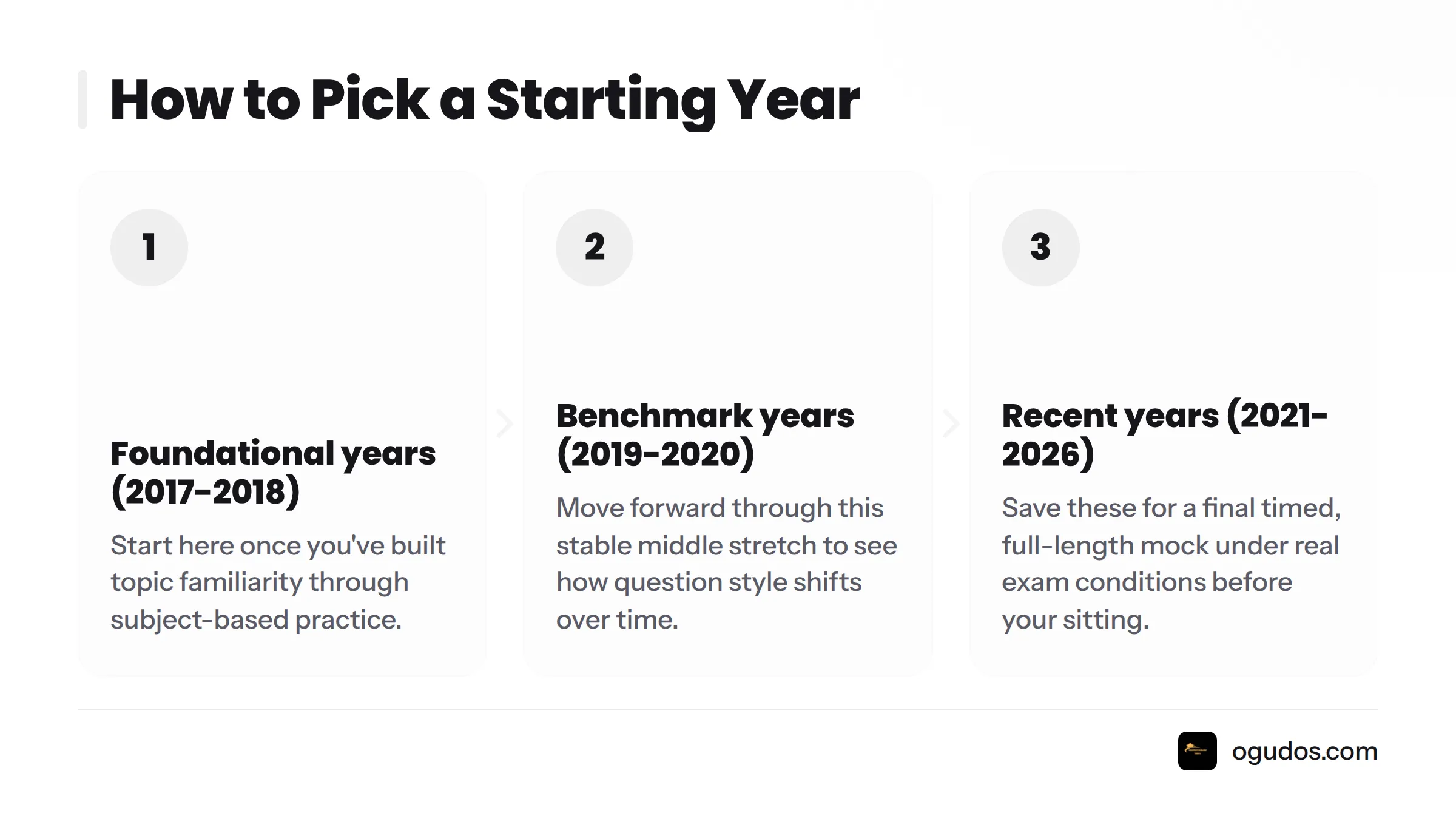
2017-2018 - Foundational years; use these once you've built topic familiarity through subject-based practice.
2019-2020 - A solid middle stretch. The 2019 Economics WASSCE paper and the 2020 questions set are frequently used as benchmark years because they reflect a stable syllabus before pandemic-era scheduling changes.
Recent years (2021-2026) - Save these for timed, exam-condition simulation closer to your actual sitting date.
How to pick a starting year:
If you're beginning, start with the oldest available year in your weakest subject. The questions are usually more direct.
Once you're comfortable, move forward chronologically, noting how question style shifts.
Reserve the two most recent years for a final, full-length timed mock under real exam conditions.
Never start with the newest year first. You'll use up your best practice material before you've built the skill to use it well.
A Decade of Mentoring: Which Subjects and Years Candidates Practise Most
Over ten years of guiding Nigerian students through WASSCE and related O'level exams, a consistent pattern emerges. Mathematics and English Language get practised first and most often, usually because they're compulsory and candidates feel the most anxiety about them. Biology, Chemistry, and Physics come next, typically once a student picks a science track.
Here's what I see repeatedly: candidates want to jump straight to the most recent year's paper, thinking "newer means more relevant." I talk almost every mentee out of it. The most recent one or two years are far more useful as a final timed simulation under real exam conditions than as an early learning tool. Work through 2017 or 2018 papers while building comfort with a topic. Save 2024, 2025, and 2026 papers for the week before your exam, when you want an honest read on where you actually stand.
Economics is another subject candidates underuse. The 2019 Economics WASSCE paper, for instance, is one I regularly point students toward because its theory section covers demand and supply, national income, and international trade in a way that maps closely onto how the subject gets tested most years.
A Step-by-Step Routine: How to Use WAEC Past Questions
This is the exact routine I walk mentees through once they've chosen their subjects and gathered papers across a few years.
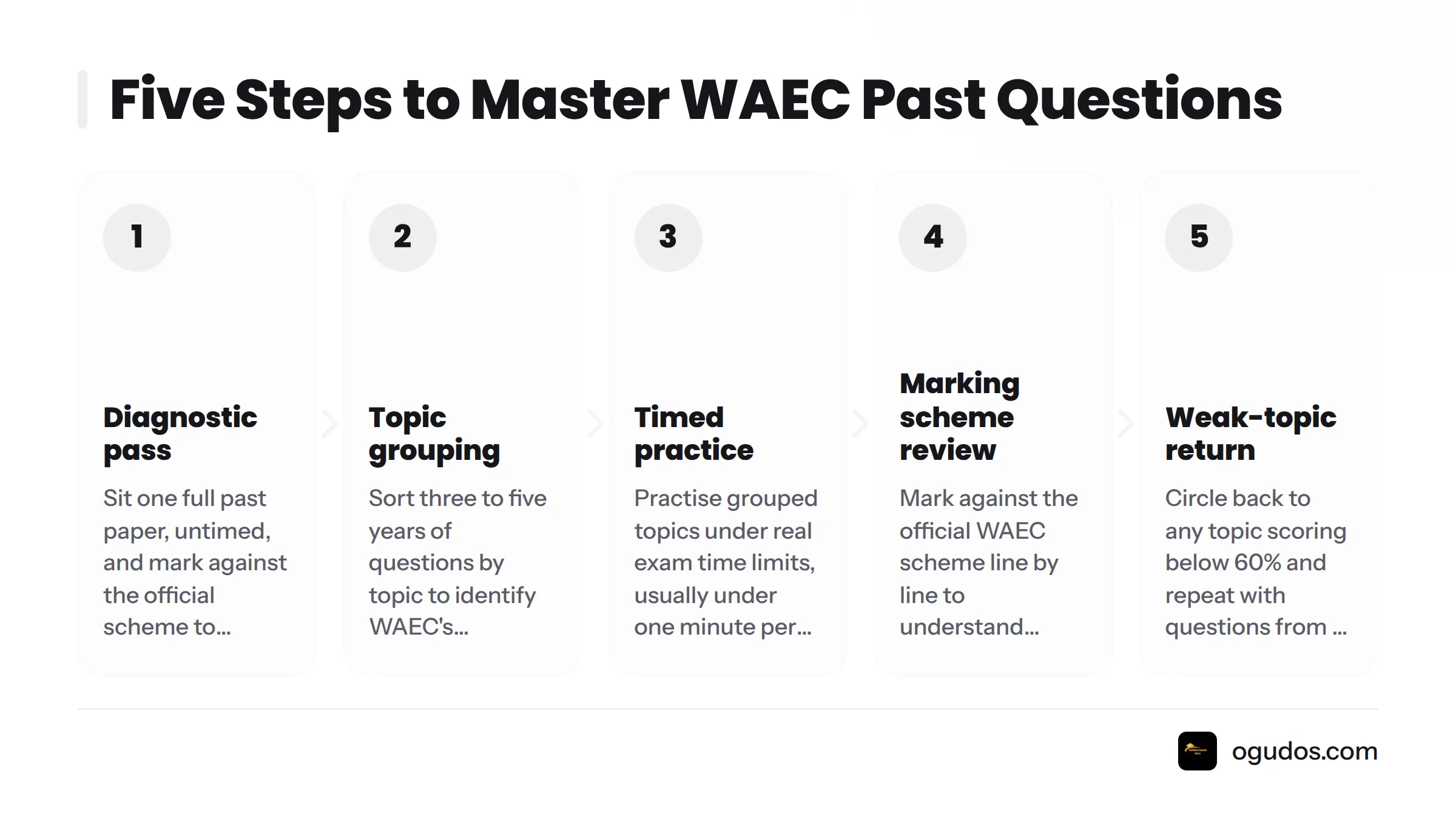
Step 1: Diagnostic pass. Sit one full past paper, untimed, in a subject where you feel average. Mark it honestly against the official marking scheme. This tells you where you actually stand, not where you assume you stand.
Step 2: Topic grouping. Go through three to five years of objective and theory questions and sort them by topic rather than by year. You'll quickly see which topics appear almost every year (these are your priority revision areas) and which show up rarely.
Step 3: Timed practice. Once topics are grouped, practise them under strict time limits matching the real exam. For objective papers, that usually means under a minute per question. For theory papers, allocate time based on the question's mark value.
Step 4: Marking scheme review. After every timed session, mark against the official WAEC marking scheme line by line, not just the final answer. Theory papers award marks for method and workings, so check whether you're losing marks on steps, not just conclusions.
Step 5: Weak-topic return. Circle back to any topic where you scored below 60% and repeat steps 1 through 4 for that topic alone, using a different year's questions, before moving to your next subject.
Quick checklist version:
Diagnose honestly with one untimed paper
Group questions by topic across several years
Practise under exam timing
Mark against the official scheme, step by step
Return to weak topics with fresh questions
How many years should I practise? Three to five years of past questions per subject is realistic and effective. Fewer than three and you won't see enough topic repetition to spot WAEC's patterns. More than five tends to deliver diminishing returns since the extra time is better spent on timed practice and weak-topic review than accumulating more papers.
Practical and Objective Papers: What Each Demands
Each paper type requires a different kind of attention. Treating them identically is one of the most common mistakes candidates make heading into WAEC.
Paper type | Typical time allocation | Format | What to focus on |
|---|---|---|---|
Objective | 1 hour to 1 hour 30 minutes | Multiple choice, 40-60 items | Speed, elimination technique, broad syllabus recall |
Theory/Essay | 2 to 3 hours | Structured written answers, choice of questions | Full workings, clear structure, mark allocation per step |
Practical | 2 to 3 hours (separate sitting) | Lab-based or observation tasks with written report | Accurate data recording, correct units, following instructions exactly |
For science candidates, the physics practical past questions deserve special attention because the practical paper rewards process as much as outcome. Examiners allocate marks for how you record data, not only whether your final figure is correct. A tidy, correctly labelled table can save marks even when a calculation drifts slightly.
After You've Practised: What Comes Next
Once you've worked through a few years of past questions per subject and feel steady on your weak topics, shift into full timed mocks that combine objective, theory, and (where relevant) practical components in one sitting, exactly as WAEC schedules them. Pick one subject and one year right now, set a timer, and treat it like the real thing.
Two things sit outside this page's scope. Once your exam is written and your result is out, you'll want to check your WAEC result, and if you're unsure how your raw scores convert into the grades on your certificate, the dedicated explainer on how WAEC grades each paper covers that in detail. Both are worth bookmarking now, while you're still in the practice phase, so you're not scrambling for information later.
If you want a broader view of how WAEC is adjusting its question style for the newer curriculum, this breakdown of upcoming WASSCE question patterns is a useful watch.
Frequently Asked Questions
Are WAEC past questions still useful for the 2026 exam?
Yes. WAEC draws from a stable syllabus that changes gradually, not from scratch each year, so topic patterns, question phrasing, and mark distribution from recent past papers remain directly relevant to the 2026 exam. The core skill past questions build, recognising how WAEC phrases and weights questions, doesn't expire.
How many years of past questions should I practise?
Three to five years per subject gives enough repetition to spot WAEC's recurring topics and question styles without wasting time hoarding papers you'll never properly review. Reserve your most recent one or two years for a final timed mock closer to your exam date.
Do past questions come with answers?
Reputable past question sets include either full answers or the official WAEC marking scheme, which shows exactly how marks are allocated for each step of a theory answer. Always mark against the official scheme rather than a generic answer key, since the scheme shows you where marks are actually won or lost.
Can past questions replace my textbooks?
No. Past questions show you how WAEC tests a topic, but they won't teach you a concept from scratch if you've never covered it in class. Use your textbooks and the WAEC syllabus to learn the material first, then use past questions to practise applying it under exam conditions.
For a candid, student's-eye view of what actually worked during exam preparation, this account from a high-scoring WASSCE candidate pairs well with the routine above.
Whatever subject you tackle first, treat every past paper the same way: diagnose, group by topic, time yourself, mark against the real scheme, and return to what's weak. That's the whole system. For more exam-prep resources and mentoring-backed study guides, visit Ogudos Scholars and keep building from here.


Comments
Post a Comment